NITDA Contemplates Collaboration With CBN To Drive Regulation On Emerging Tech, Digital Payment

By Angeline Mgbele, Bureau Chief, North
In a deliberate and intentional step to ensure Nigeria’s Payments System gets more global recognition and is domestically utilised across the country, the Director-General(DG) of the National Information Technology Development Agency (NITDA), Mallam Kashifu Inuwa Abdullahi, has restated the need for the Central Bank of Nigeria (CBN) and Financial Institutions in the country to collaborate with the Agency in order to leverage emerging technologies such as Artificial intelligence (AI) and Data Analytics to deepen digital payments.
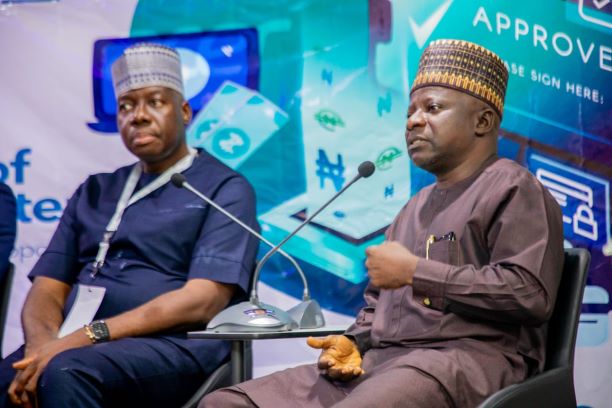
Mallam Inuuwa Abdullahi made this known during a panel discussion segment at the Central Bank of Nigeria’s 2023 Payments System Management Departmental Retreat programme.
The NITDA DG who was represented at the event by the National Director, National Centre for Artificial intelligence and Robotics (NCAIR), Engr Ya’u Garba, alluded to the fact that financial technology (FinTech) had so far shown immense ability in driving Nigeria’s performance in the industry and Environmental, Social, and Governance (ESG), especially with the application of developmental regulation approach and enabling policies co-created by the tech ecosystem.
According to Mallam Abdullahi, deepening collaborations with key stakeholders would fast track the realisation of the goal, adding that upping the game in digital payments would not only continue to put Nigeria at the forefront as Fintech driven economy but also enhance consumers’ user experience and help move many people out of poverty.
Responding to questions regarding Nigeria’s efforts toward dealing with the opportunities and threats posed by Artificial intelligence, Abdullahi explained that the Federal Government having noticed that the trajectory of AI models which had moved from linearly to geometrical in proportions had in the previous administration, started working on Artificial intelligence Policy through the Agency which he said would be soon be unveiled to the public.
“This AI Policy will form the basis on which all the rules will be highlighted and Agencies like NITDA, which is the implementation arm will be talking about the strategies, framework and guidelines to navigate through its adoption and deployment”.
“Although artificial intelligence is often regarded as a double edged sword, the potential and benefits are tangible but not without a lot of threats, and that is apart from the biases that abound, notwithstanding, our regulatory approach has always been not to stifle innovation.”, Abdullahi noted.
The NITDA boss who also mentioned other policies of the Federal Government for the industry, maintained that the policies were start-up ecosystem- friendly.
While avowing that there was the need for measures to be deliberately taken to reap the benefits and forestall the impending threats of AI, he emphasised that NITDA would be working collaboratively with CBN as with others, in regulating the AI space, stressing that if CBN adopted a particular technology, the potential of such tech to move quickly was high.
The NITDA boss told the audience that the Start-up Bill, which was passed by the National Assembly and assented to by former President Muhammadu Buhari in October 2022, would address almost, if not all the bottlenecks plaguing the tech ecosystem.
The Fintech industry, according to him, was blazing the trail, but said there were a lot more to be tapped from, if AI was explored and exploited accordingly.
He went further to stress that government needed to work with the United Nations, World Bank and others to see how they could help build the infrastructure for FinTech, in order to foster digital payments and possibly close the digital gap.
“The Startup Act is deemed to be a positive step forward for the country’s startup ecosystem, and it is expected to have a significant impact on businesses in the technology and innovation space”.
“We have other policies tailored towards the bigger picture, like the 3MTT programme by the Federal Ministry of Communications, Innovation & Digital Economy which is expected to generate a pipeline of technical talent in line with President Bola Ahmed Tinubu’s vision of creating 2 million digital jobs by 2025, National Broadband Plan, Digital Identity Policy and the National Financial Policy which drive the financial inclusion in the country,” Abdullahi affirmed.
Earlier, while welcoming guests, the Director, Payments System Management Department, CBN, Musa Jimoh harped on the need to look into the future and embrace things that were contemporary to Nigeria and the world at large and ensure that all the thinking behind Payments system should be hinged on how it could benefit the common man on the street.
“Everything we do in Central Bank of Nigeria, if it cannot benefit the common man on the street, then we have done nothing because the payments system is not for us but for the public good, especially as everybody uses it.
“As such, our thinking should always be what can we do to ease the pain, reduce cost, serve and make things more efficient and available to the common man on the street and indeed to all Nigerians, whether in the country or in the diaspora”, Musa sued.
The Retreat of Payments System Management Department of the Central Bank of Nigeria brought together payments industry experts and stimulated discussions around innovations in the Payments System space.
The retreat had as its main theme: “Future of Payments System: Opportunities, threats and propositions.