
By Kingsley I. Ilechukwu, Bureau Chief, South West, Nigeria and Angeline Mgbele, Bureau Chief, Northern Nigeria
The National Information Technology Development Agency (NITDA), in collaboration with the SATH Foundation, is advancing efforts to strengthen Nigeria’s technology ecosystem through the Nigeria Tech Outlook, an initiative designed to guide investment, inform policymaking and accelerate technology adoption across key sectors of the economy.
The foregoing is contained in a press statement e-signed by the Director of Corporate Communications and Media Relations at NITDA, Hajiya Hadiza Umar, Wednesday.
According to the statement, the Director-General of NITDA, Mallam Kashifu Inuwa Abdullahi, highlighted the initiative at the Tech Outlook in Lagos, south west, Nigeria, emphasising the need to translate Nigeria’s wealth of technology talent, innovative ideas and entrepreneurial achievements into a globally competitive innovation ecosystem.
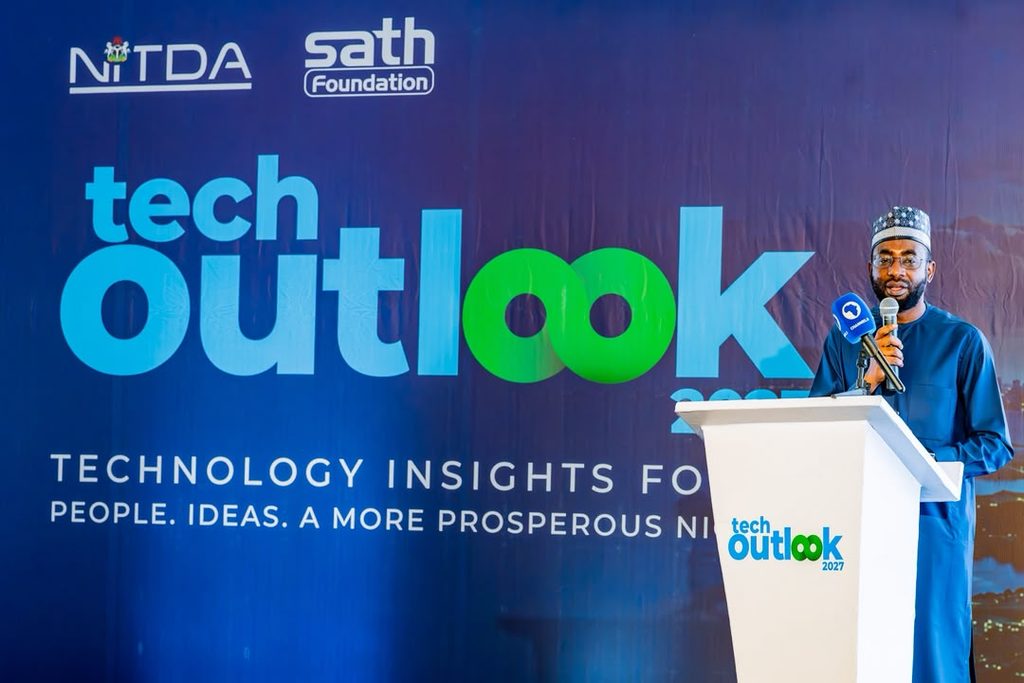
Malam Abdullahi noted that although Nigerian innovators and technology companies had achieved significant success, individual accomplishments alone could not guarantee global competitiveness adding a stronger ecosystem requirds reliable digital infrastructure, supportive policies, strategic investments and collaboration among government, industry leaders, investors and innovators.
According to Abdullahi, the Nigeria Tech Outlook would provide evidence-based insights into the country’s technology landscape, helping stakeholders understand the level of technology access, adoption and its contribution to productivity across the economy. The first edition of the report, he said, would examine five sectors: financial services, telecommunications, commerce and trade, government services, and healthcare.
Highlighting the importance of research in identifying market opportunities, the NITDA boss disclosed that more than 80 per cent of over 2,000 Nigerians surveyed expressed willingness to use telemedicine services, while fewer than 20 per cent had ever used them. He explained that such findings could help investors identify underserved markets, encourage innovators to develop relevant solutions and guide policymakers in addressing barriers to technology adoption.

According to him, the Tech Outlook would also examine emerging technologies, including artificial intelligence and autonomous systems, alongside digital trust and governance, cybersecurity, data privacy, cloud computing and digital infrastructure, saying these areas were expected to inform discussions on how Nigeria could strengthen its technological capabilities and expand the adoption of digital solutions across critical sectors.
Abdullahi stressed that technology policies and regulations must be grounded in research and industry realities rather than assumptions and called on industry leaders to contribute their expertise to reviewing the findings and identifying practical interventions that would support investment, innovation and economic growth.
The initiative is expected to provide government with insights for evidence-based policymaking, businesses with a clearer understanding of technology adoption gaps, investors with information to guide investment decisions, and innovators with opportunities to develop solutions to pressing national challenges.
The first edition of the Nigeria Tech Outlook is scheduled for launch at the Digital Nigeria International Conference. Through the collaboration between NITDA and the SATH Foundation, the initiative seeks to strengthen Nigeria’s technology intelligence, unlock new investment opportunities and position the country to build a globally competitive innovation ecosystem driven by research, collaboration and homegrown solutions.
On his part, the founder of SATH Foundation, Collins Onuegbu, said that technology had become central to Nigeria’s economic and social development, transforming how people worked, traded, communicated, learned and accessed public services.
Mr. Onuegbu added that digital innovation was reshaping business operations, government engagement, security, productivity and national competitiveness.
He noted that conducting the assessment annually would create institutional memory, enabling stakeholders to track progress, evaluate existing priorities and build a stronger evidence base for decisions concerning the country’s digital future.
He emphasised that the gathering should move beyond speeches to encourage meaningful engagement and actionable outcomes that supported Nigeria’s technology development, economic growth and national competitiveness.