Intrado Teams With Toyota To Deliver Crash Data Directly To PSAPs Via Next-gen-911 Standard
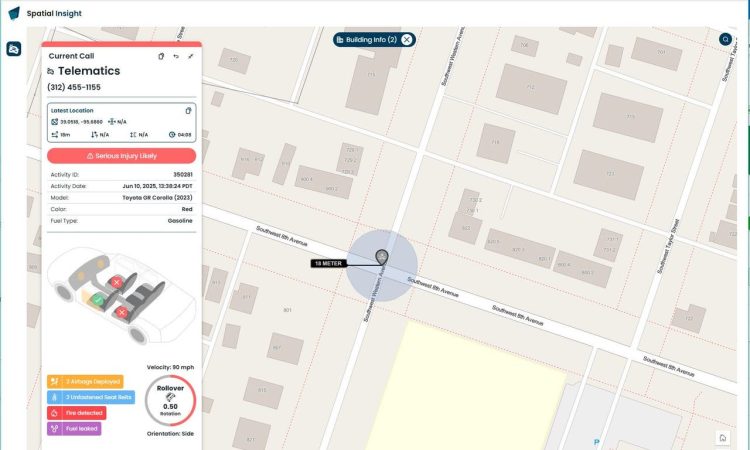

Key 911 vendor Intrado Life & Safety announces a collaboration with Toyota Connected North America to deliver Advanced Automatic Crash Notification (AACN) telematics data to 911 centers in a format that complies with the NENA i3 standard
By Donny Jackson, Editor
Key 911 vendor Intrado Life & Safety recently announced a collaboration with Toyota Connected North America to deliver Advanced Automatic Crash Notification (AACN) telematics data to 911 centers in a format that complies with the NENA i3 standard.
Intrado’s vice president of technology, John Snapp said telematics providers like OnStar have long leveraged vehicle-sensor capabilities to provide key information about accidents to public-safety agencies, but this data often was shared verbally or via a proprietary method outside the native 911 system. In contrast, this lntrado-Toyota initiative is designed to deliver AACN (see photo above) information and the Vehicle Emergency Data Set (VEDS) to public-safety answering points (PSAPs) via an Emergency Services IP network (ESInet) built to the i3 standard, he said.
“Today, some of the vendors—including vendors we’re working with—are passing some of that data through, but it’s always [through] a proprietary, over-the-top interface,” Snapp said during an interview with IWCE’s Urgent Communications. “This one [from Intrado and Toyota], with the AACN and the i3 VEDS, is passing data natively from any telematics provider through any ESInet and into any call-handling system that supports it.
“I see this as one of the first promises of what i3 is that’s starting to really come out there, instead of just being a call or ALI data [transmission platform]. We’re finally starting to pass true data through.”
Intrado plans to have this capability “in production” by the end of June, and the company expects to demonstrate the technology during the annual NENA Conference & Expo that is scheduled to begin on Saturday in Long Beach, Calif.
Intrado initially will deliver AACN and VEDS data from Toyota vehicles and through ESInets from AT&T, according to Snapp.
“We’re routing that for Toyota into any i3 network that can support it,” he said. “And there’s one network that can support it, and that’s our partner AT&T and the AT&T ESInet.
“They’ll be first one we connect to, so they’ll be the first one supporting that AACN data down to the PSAPs.”
While Toyota and AT&T are the initial partners in this initiative, Snapp emphasized that the long-term goal of this initiative is let PSAPs receive standards-based AACN and VEDS data from a variety of telematics vendors and via numerous ESInet providers.
“From the telematics side, we’ll support any telematics provider that would like us to generate this native-i3 message,” Snapp said. “We’ll support that going into any ESInet in the country that supports it for them.”
“I would expect that eventually all of the ESInets that are out there that are i3-compliant will implement this. It’s just that AT&T is the first to be the one passing it through.”
Snapp said he does not believe the ability for PSAPs to receive AACN and VEDS data directly will change the information flow in the near future, because telematics-provider call centers play a key role in limiting the number of unnecessary public-safety responses..
“It’s still probably going to go through call centers for today,” Snapp said. “The call center is there to basically validate the call to make sure that people really do need help. If they say, ‘I’m just in a small fender-bender, and I don’t need anything. Don’t send anything,’ [the public-safety entity] can cancel the alert. With anything else, they can pass it through. And in many cases, it’s a button push that [call-center personnel] push; it wouldn’t be the car pushing it.
“So, they’re a triage at the beginning of it, and today they are the ones who verbally say what happens. What we’re saying is that it’s using the standards to get it through there, so it can be anybody.”
And this technology being implemented by Intrado and Toyota has some potentially intriguing long-term implications, including accelerating responses by delivering AACN and VEDS data more quickly than is possible via verbal communications, Snapp said.
“I think it makes it possible,” Snapp said. “You may still have the call center to triage and to validate it, but you just may not need to have them on the call. You could pass through all of this data, and it may be enough.
“I think it’s going to be up to the telematics providers, if they feel they want to provide that extra level of concierge service to guarantee it got through. I think time will tell, but I think this sets up to the possibility.”
Similarly, this functionality could be used to initiate a deployment in a Drone as First Responder (DFR) program, according to Snapp.
“I think it really could come into play with Drone as First Responder. The call center is not necessarily slowing down the call, but you’re not having to verbally relay the information. Now, you would have the raw information—severity, people, and particularly the latitude and longitude—and that could be fed into Drone as First Responder systems to automate a dispatch of those.
“Having that in a known format—so you know that this is a car crash, you know that this is the data, and this is my criteria for launching the drone to get it on scene—so you can figure out what other resources … to send and whether there are other cars involved, I think it could really speed [the response] up by automating that.”
In addition to helping accelerate the response to a crash, AACN data and VEDS also could be used to provide first-responder agencies with projected impact statements, based on information regarding the velocity and direction of impact, as well as the location of passengers in a vehicle, Snapp said.
“I know that’s being worked on; NHTSA is a big part of pushing for that,” Snapp said. “Every automotive vendor kind of has their own way that they’ve thought about doing it. Now, we’re trying to get to the point of consistency, so it can be used in the same way.
“Right now, we’re seeing more raw data that’s being passed, like the velocity of the impact and the angle of the impact. But that is the ultimate goal, to get to that [modeling of most likely outcomes for a vehicle collision].”
Such modeling has been promised by telematics providers for years and is being done to some extent, but the potential for this information to improving responses is significant, according to Snapp.
“If this was a rollover, they’re going to dispatch it differently than if it was low-impact, front-end collision versus T-Bone collision versus no seatbelts being worn and how many occupants they have in the vehicle,” he said.
“That data is really critical, and a lot of vendors are starting to do that.”