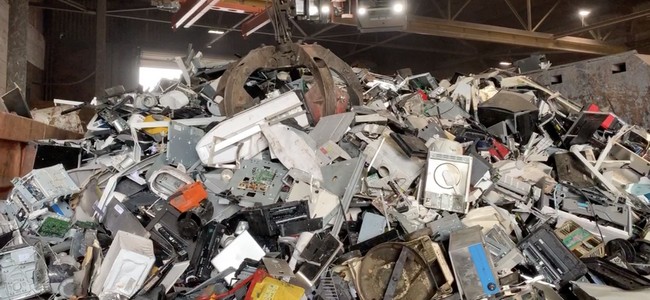

Discarded electrical and electronic equipment (such as phones, laptops, fridges, sensors and TVs) is referred to as e-waste or Waste, Electrical and Electronic Equipment (WEEE).
E-waste is a growing challenge, matching the growth of the information and communication technology (ICT) industry. There are currently more mobile cellular subscriptions on Earth than there are humans. Since 2014, the global generation of e-waste has grown by 9.2 million metric tonnes (Mt) (21%).
The fate of over four-fifths (82.6% or 44.3 Mt) of e-waste generated in 2019 is unknown, as well as its impact on the environment. E-waste contains substances that can be hazardous to human health and the environment if not dealt with properly – including mercury, cadmium and lead. An estimated total of 50 tonnes of mercury might be contained within the 44.3 Mt of e-waste whose destination is unknown.
The global regulatory environment for e-waste is rather weak. Currently, only 78 out of 193 (40% of countries) are covered by an e-waste policy, legislation or regulation, according to the ITU.
By adopting the Connect 2030 Agenda, ITU Member States have set a global ITU e-waste target for 2023 to increase the global e-waste recycling rate to 30 per cent and to raise the percentage of countries with an e-waste legislation to 50 per cent. They have also committed to reducing the volume of redundant e-waste by 50 per cent.
Tackling e-waste helps to address the Sustainable Development Goals, in particular goals 3, 8, 9, 11, 12 and 13.
Challenges
E-waste is referred to as almost any discarded household or business item with circuitry or electrical components with a power or battery supply.
Matching growth in ICT networks and services, latest estimates show that the world now discards approximately 53.6 million Mt of e-waste per year – only 17.4 per cent is formally collected and recycled. In 2019, the fate of 44.3 Mt of generated e-waste was unknown – this waste was either not documented, being discarded in landfill, burned or illegally traded and treated in a sub-standard way. With the current approach to end-of-life management of e-waste, globally, a transition to a circular economy for ICT equipment in particular, is proving challenging.
Up to 69 elements from the periodic table can be found in electrical and electronic equipment (EEE). These include critical raw materials and precious metals. E-waste can result in the unnecessary loss of scarce and valuable natural materials, through failure to recycle other less toxic, but high-value rare materials, such as gold, platinum, and cobalt, putting pressure on the limited natural resources available.
For example, one ton of discarded mobile phones or PCs can contain up to 280 grams of gold, as well as high levels of base metals. E-waste contains toxic additives or hazardous substances, commonly including heavy metals such as mercury, cadmium and lead, and chemicals such as brominated flame retardants which can pollute land, air and aquatic environments and pose significant health risks, especially if treated inadequately.
Improper e-waste management can also contribute to global warming, especially since refrigerants in some temperature exchange equipment are potent greenhouse gases. A total of 98 Mt of CO2-equivalents were potentially released into the atmosphere globally in 2019 from the discarded fridges and air conditioners that were not managed in an environmentally sound manner. More and more products such as smart fridges, freezers and smart washing machines are increasing their connectivity capabilities, in the growing Internet of Things (IoT). Furthermore, products that were not traditionally electrified may often now incorporate circuitry, including wearable electronics.
In addition, e-waste puts the health and lives of some of the world’s poorest adult and child workers who dispose of e-waste at risk, by exposing them to toxins and poisoning.
Opportunities
On the upside, e-waste contains several valuable raw materials such as gold, copper and iron. In 2019, the value of raw materials in e-waste generated was estimated at US$57 billion. At the current collection and recycling rate (17.4%), a raw material value of US$10 billion USD could be recovered. Under the right conditions, with due health and safety precautions, e-waste recycling and refurbishment activities could also potentially create green jobs worldwide.
Through greater collaboration, multinationals, small- and medium-sized enterprises (SMEs), entrepreneurs, academia, trade unions, civil society and associations could create a ‘circular economy’ for electronics where the waste is designed out, the environmental impact could be reduced and decent work created for millions.
A system in which all discarded products are collected and then the materials or components reintegrated into new products could:
- reduce the need for new raw materials, waste disposal and energy;
- create new economic growth, ‘green’ jobs, and business opportunities; and
- substantially reduce carbon dioxide emissions, compared to raw resource extraction through mining or industrial extraction.
At the industry level, companies can research and establish their full supply chain, from sourcing to manufacture to distribution, to collection and disposal. Supply chain management must include responsible and ethical device disposal, as well as educating consumers about the importance of disposing of their devices responsibly.
Consumers can try to: get ICT equipment repaired instead of replaced; delay upgrading or exchanging functional smartphones for the latest model; use certified recycling points or disposal firms; consider giving ICT equipment a ‘second life’ through resale.
Reliable, official and comparable e-waste data and statistics provide the foundation for the development of sound domestic e-waste management policies and legislation. As of 2020, people from 60 different countries have been trained by the Global E-waste Statistics Partnership (GESP) to compile national e-waste statistics through an internationally adopted methodology. However, between 2017 and 2019, about 9 countries (other than EU) have officially started collecting e-waste data and estimations.
ITU’s Contribution
In 2018, ITU Member States set a global e-waste target for 2023 to increase the global e-waste recycling rate to 30 per cent and raise the percentage of countries with an e-waste legislation to 50 per cent. In 2019 the global e-waste formal recycling rate stood at 17.4 per cent and 78 countries had developed e-waste policy, legislation or regulation (covering 71% of the world’s population).
The ITU is a founding member of the Global E-waste Statistics Partnership, which also includes the United Nations University (UNU) and the International Solid Waste Association (ISWA). As part of the Global E-waste Statistics Partnership, ITU jointly publishes the Global E-waste Monitor which is the only source providing a global overview of the e-waste situation, based on data gathered and statistical estimations. Several Regional E-waste Monitors are produced by the Partnership, providing further clarity on the status of the world’s e-waste challenges.
The Global E-waste Statistics Partnership has launched a new open source portal globalewaste.org that visualizes e-waste data and statistics globally, by region and by country, for policy-makers, industry, academia and the public. The portal includes e-waste data from Global and Regional E-waste Monitors for most countries, such as: the amount of e-waste generated in total and per capita and discarded prior to any collection, reuse, treatment, or export; the amount of e-waste formally collected in total and per capita and regulated by environmental protection laws specifically designed for e-waste; and e-waste legislation by country, where applicable.
The UN E-waste Coalition was launched in 2018, including ITU and a number of other UN system organizations (the BRS Secretariats, ILO, ITC, UN Environment, UN-Habitat, UNIDO, UNITAR, UNU and WHO), with support from the World Economic Forum and World Business Council for Sustainable Development.
The WEEE Forum organizes International E-waste Day in October each year, which ITU is supporting in 2020. This global awareness initiative aims to raise the public profile of e-waste recycling and encourages consumers to recycle their e-waste.
ITU helps Member States build capacity in addressing e-waste, by supporting them in identifying their national e-waste policy framework. Such a framework should comprise e-waste policies and legislation with innovative financing mechanisms and monitoring and control capabilities.
ITU is also a member of the Solving the E-waste Problem (StEP) initiative, a programme involving the UNU, which is dedicated to facilitating global and collaborative efforts in reducing e-waste through policy change, product re-design, re-use, recycling and capacity building. The Global E-waste Monitor report is one of the results of this collaboration.
The ITU-T Study Group 5 “Environment, climate change and circular economy” has developed a series of international standards (i.e. ITU-T Recommendations) to support city stakeholders and the ICT sector in developing a sustainable e-waste management system, evaluating the environmental impacts of WEEE, defining a safe procedure for recycling rare metals in ICTs, implementing the e-waste reduction target of the Connect 2030 Agenda, moving towards a circular economy and more. ITU also organizes the Green Standards Week (GSW), a global platform where policy-makers, field experts, city planners, regulators, standardization experts, civil societies, and other stakeholders can come together to discuss the role of ICT in facilitating smart sustainable cities and unlocking the potential of a circular economy. The 9th edition of GSW, which was held in Valencia from 1 to 4 October 2019, hosted a forum “Frontier Technologies to Tackle Climate change and Achieve a Circular Economy”. The United for Smart Sustainable Cities (U4SSC) initiative, which is a UN initiative coordinated by ITU and UNECE with the support of 14 other UN agencies and programmes dedicated to support the transition to smart sustainable cities, is developing deliverables that encourage circularity actions in cities, including guidelines on strategies for circular cities.
ITU has published a report entitled “Turning digital technology innovation into climate action” and has published “Frontier technologies to protect the environment & tackle climate change”, to highlight the emerging role of ICTs and digital technologies in accelerating climate actions and tackling the e-waste challenge.
* Editor’s Note: Follow the link below to see the chart/image in the original article: https://www.itu.int/en/mediacentre/backgrounders/Pages/e-waste.aspx