
Eight new rice varieties developed using nuclear techniques are helping Burkina Faso grow more of its own rice and strengthen food security
By Fatma Sarsu and Dejana Tadic, Department of Nuclear Sciences and Applications
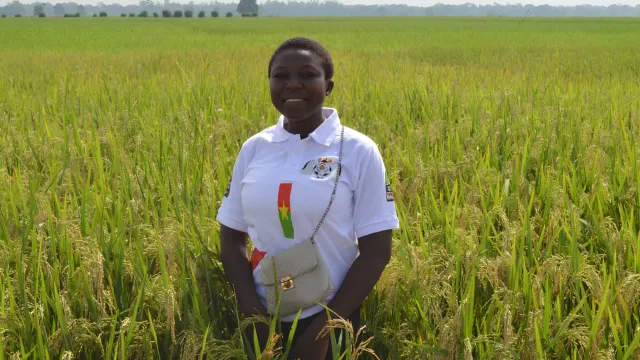
For farmers in Burkina Faso, producing more rice starts long before seeds are planted in the field. It begins with science. Scientists in the country have used nuclear techniques to develop eight new rice varieties that yield more, mature faster and offer improved grain qualities, helping boost local food production and reduce reliance on rice imports.
Released in 2025, the varieties show how scientific innovation can move from the laboratory to farmers’ fields and, ultimately, to the food people eat. The achievement was made possible with support from the IAEA and the Food and Agriculture Organization of the United Nations (FAO) under the Atoms4Food initiative.
Strengthening Burkina Faso’s Rice Production with Nuclear Science
Rice consumption in Burkina Faso has doubled over the past decade, yet around half of the country’s rice is imported. Strengthening domestic rice production has become a national priority, with Burkina Faso’s national rice breeding programme central to this effort.
For scientists in Burkina Faso, the challenge is not simply to develop rice that yields more, but varieties that respond to local growing conditions and to the needs of farmers and consumers.
Using mutation breeding, a technique that uses radiation to speed up the natural process of genetic variation, scientists selected plants with desirable characteristics to develop new rice lines. Capacity-building and expert support through the IAEA technical cooperation programme helped strengthen national expertise in applying the technique and taking promising lines through development and field testing.
The effort resulted in the release of eight new rice varieties combining characteristics that matter from the field to the table. They yield between 9 and 11 tonnes per hectare and mature in just 95 to 106 days. By comparison, varieties already in Burkina Faso’s national catalogue typically yield between 4 and 6 tonnes per hectare and have longer growing periods.
But producing more rice was not the only objective. Scientists also selected characteristics that respond to consumer needs and preferences. Among the new varieties are two with large grains, two rich in resistant starch and a waxy, or sticky, rice variety.
“The significance of this achievement goes beyond the eight new varieties. With support from the IAEA and FAO under Atoms4Food, we have strengthened scientific capacity in Burkina Faso that enables us to continue developing crops that respond to changing growing conditions and to the needs of our farmers and consumers,” said Imaël Henri Nestor Bassolé from Université Joseph Ki-Zerbo.
From Research to Release
Developing a promising rice line is only the first step. Before a new variety can reach farmers, it needs to be tested under local growing conditions, evaluated for farmer and consumer needs, and officially registered. In Burkina Faso, strengthened expertise in mutation breeding enabled researchers to take promising rice lines through this process, from laboratory development and field testing to variety release.
Building on earlier successes, the IAEA-FAO collaboration supported the registration process, the establishment of demonstration fields in Bama and Banzon, and efforts to develop future generations of improved rice varieties that combine the most desirable traits identified in the newly released lines. In June 2025, eight of the eleven advanced mutant rice lines were officially registered in Burkina Faso’s National Catalogue of Plant Species and Varieties, marking a landmark achievement for the country’s rice research and production sector.
Bringing Benefits to Farmers
With the new varieties officially approved, efforts are underway to expand seed production and make them more widely available to farmers. The demonstration fields are proving their performance under local growing conditions, helping move the innovation from research into production.
“The progress achieved in Burkina Faso demonstrates how nuclear science and technology can help countries address food security challenges while strengthening national research capacity. Through Atoms4Food, we are working with countries to build on successes like these and support sustainable improvements across agrifood systems,” said Director of the Joint FAO/IAEA Centre of Nuclear Techniques in Food and Agriculture Dongxin Feng,.
In May 2025, Burkina Faso hosted the first joint Atoms4Food Assessment Mission, which identified priority areas for the next phase of support.