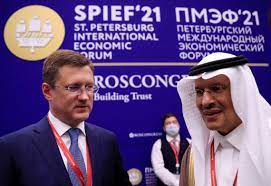

Saudi Arabia’s Energy Minister Prince Abdulaziz bin Salman met Russian Deputy Prime Minister Alexander Novak on Friday in Riyadh, the Saudi energy ministry said on Twitter.
The two discussed the latest developments in the work of the joint Saudi-Russian committee as well as opportunities for cooperation between their countries, the ministry added.
Their meeting came ahead of a meeting of The Organization of the Petroleum Exporting Countries and its allies, known as OPEC+, set for Aug 3.
The organization is under pressure — particularly from the US — to increase production in order to reduce global oil prices.
US President Joe Biden visited Saudi Arabia this month hoping to strike a deal to open the taps, but he is set to be disappointed, OPEC+ sources have told Reuters.
The news agency is reporting that the group will consider keeping oil output unchanged for September, saying a modest increase would be discussed.
Saudi Arabia is clear that OPEC+ is playing a vital role in maintaining stability in the oil markets and actively considers all options.
Speaking at an Arab News Japan Roundtable event on July 19, Saudi Arabia’s Foreign Minister Prince Faisal bin Farhan described dialogue in the alliance as “quite robust”, and that it is “responding as needed to the requirements of the oil markets.”
“We don’t see a lack of oil in the market, there is a lack of refining capacity,” he added.
At its last meeting, in July, OPEC+ agreed to stick to plans to increase production by 648,000 barrels per day for the month of August.
The prospect of the group sticking to modest increases when it meets next month saw oil prices rise in European trading on Friday.
Brent crude futures for September settlement, due to expire on Friday, gained US$2.34 to US$109.48 a barrel by 0933 GMT for its highest since July 5. The more active October contract was up US$2.30 at US$104.13.
US West Texas Intermediate crude futures rose US$2.16 to US$98.58 a barrel.
“The oil market in Europe is considerably tighter than in the US, which is also reflected in the sharply falling Brent forward curve,” said Commerzbank analyst Carsten Fritsch.
Asian shares mixed on US rally, China economic growth woes
TOKYO: Asian shares were mixed Friday, as Chinese shares sank after leaders acknowledged the official 5.5 per cent growth target for this year won’t be met.
Investors appear to have grown more convinced that the Federal Reserve may temper its aggressive interest rate hikes aimed at taming inflation after the Commerce Department reported the US economy contracted at a 0.9 per cent annual pace in the last quarter.
That followed a 1.6 per cent year-on-year drop in the first quarter.
Investors were also cautiously eyeing regional tensions over China’s stance on Taiwan after President Joe Biden and China’s Xi Jinping spoke for more than two hours on Thursday.
China left no doubt it blames the US for a deteriorating relationship, but the White House said call’s aim was to “responsibly manage our differences and work together where our interests align.”
Hong Kong’s Hang Seng index dropped 2.4 per cent to 20,123.55 and the Shanghai Composite index declined 1 per cent to 3,250.64 after China’s leaders acknowledged the struggling economy won’t hit its official 5.5 per cent growth target this year.
The announcement after a planning meeting of the ruling Communist Party said Thursday that Beijing will try to prop up sagging consumer demand but will stick to strict anti-COVID-19 tactics that have disrupted manufacturing and trade.
It underscores the high cost Xi’s government is willing to incur to stop the virus in a politically sensitive year when he is widely expected to try to extend his term in power.
Japan’s benchmark Nikkei 225 lost 0.2 per cent to 27,801.64, while Australia’s S&P/ASX 200 gained 1.0 per cent to 6,945.20. South Korea’s Kospi added 0.7 per cent to 2,451.50.
Japanese government data showed factory output in June jumped 8.9 per cent from the previous month, marking the first rise in three months. The recent easing of pandemic lockdowns in China has helped boost Japanese production.
“On the economic data front, easing China’s restrictions also drove a stronger-than-expected June output for Japan, with China’s reopening potentially having a positive knock-on impact across the region as well into the second half of the year,” said market strategist at IG in Singapore, Yeap Jun Rong.
A surge in COVID-19 infections to record levels in many parts of Japan has raised concern. But regional head of research Asia-Pacific at ING Robert Carnell believes that Japan’s second quarter GDP, or gross domestic product, will rebound marginally from the first quarter’s contraction.
On Thursday, the S&P 500 rose 1.2 per cent to 4,072.43, while the Dow added 1 per cent to close at 32,529.63. The Nasdaq gained 1.1 per cent to 12,162.59. The Russell 2000 rose 1.3 per cent to 1,873.03.
Consecutive quarters of falling GDP are an informal, though not definitive, indicator of what economists call a technical recession.
The GDP report signaled weakness across the economy. Consumer spending slowed as Americans bought fewer goods. Business investment fell. Inventories tumbled as businesses slowed their restocking of shelves, shedding 2 percentage points from GDP.
The Federal Reserve has made slowing the US economy to tame the highest inflation in 40 years its goal by raising interest rates, most recently on Wednesday. The latest GDP report, along with other recent weak economic data, could be giving some investors confidence that the central bank will be able to ease up on the size of any further rate hikes.
The central bank raised its key short-term interest rate by 0.75 percentage points on Wednesday, lifting it to the highest level since 2018. The move sparked a broad market rally led by technology stocks that helped give the Nasdaq its biggest gain in over two years. The major indexes are now all on pace for a weekly gain, extending Wall Street’s strong July rally.
In a busy week of corporate earnings reports investors have focused on what companies are saying about inflation and the impact rising interest rates are having on their business and customers.
Spirit Airlines shares rose 5.6 per cent after JetBlue said it agreed to buy the budget airline for US$3.8 billion to create the nation’s fifth largest airline. A day earlier, Spirit’s attempt to merge with Frontier Airlines fell apart. Frontier Airlines vaulted 20.5 per cent.
In energy trading, benchmark US crude gained 40 cents to US$96.82 a barrel in electronic trading on the New York Mercantile Exchange. It lost 84 cents to US$96.42 on Thursday.
Brent crude, the international pricing standard, gained 36 cents to US$102.19 a barrel
In currency trading, the US dollar fell to 132.67 Japanese yen from 134.27 yen late Thursday. The euro cost US$1.0247, up from US$1.0199.
Oil prices steady as market weighs tight supply against recession fears
Oil prices were broadly steady on Friday, lifted by supply concerns as attention turns to the next meeting between OPEC and its allies, though fears of recession capped gains, according to Reuters.
US West Texas Intermediate crude futures for September delivery rose 67 cents, or 0.7 per cent, to US$97.09 a barrel by 0640 GMT, reversing losses from the previous session and on track for a nearly 3 percent rise for the week.
Brent crude futures for September settlement, due to expire on Friday, dipped 12 cents, or 0.1 per cent, at US$107.02 a barrel. The more active October contract climbed 48 cents, or 0.5 per cent, to US$102.31.
“It certainly feels like we are back in trade-off mode again, where sentiment is shifting between recessionary risks in H2 and a fundamentally undersupplied market,” said Stephen Innes, managing partner at SPI Asset Management.
A key driver will be the next meeting of the Organization of the Petroleum Exporting Countries and allies led by Russia, together called OPEC+, on Aug. 3.
Producers have now unwound the record 9.7 million barrels per day supply cut they agreed in April 2020, when the COVID-19 pandemic slammed demand.
“Oil prices have little chance of (posting) deep losses on the back of a weak US dollar and the ongoing supply crunch,” said CMC Markets analyst Tina Teng.
OPEC+ sources said the group will consider keeping oil output unchanged for September, but two OPEC+ sources also told Reuters a modest increase would be discussed.
A decision not to raise output would disappoint the US after President Joe Biden visited Saudi Arabia this month hoping to strike a deal on oil production.
A senior US administration official said on Thursday the government was optimistic about the OPEC+ meeting, and said extra supply would help stabilize the market.
Analysts, however, said it would be difficult for OPEC+ to boost supply much given that many producers are struggling to meet their production quotas due to a lack of investment in oil fields.
“OPEC production is constrained, though supplies are stabilizing in Libya and Ecuador. Under-investment in many member countries will keep production constrained,” ANZ Research analysts said.