
By Louis Rosenberg, Unanimous A.I.
The world of technology is rapidly shifting from flat media viewed in the third person to immersive media experienced in the first person. Recently dubbed “the metaverse,” this major transition in mainstream computing has ignited a new wave of excitement over the core technologies of virtual and augmented reality. But there is a third technology area known as telepresence that is often overlooked but will become an important part of the metaverse.
While virtual reality brings users into simulated worlds, telepresence (also called telerobotics) uses remote robots to bring users to distant places, giving them the ability to look around and perform complex tasks. This concept goes back to science fiction of the 1940s and a seminal short story by Robert A. Heinlein entitled Waldo. If we combine that concept with another classic sci-fi tale, Fantastic Voyage (1966), we can imagine tiny robotic vessels that go inside the body and swim around under the control of doctors who diagnose patients from the inside, and even perform surgical tasks.
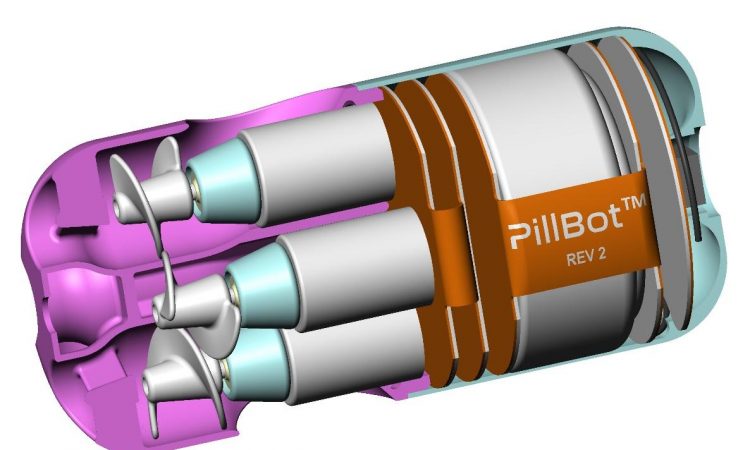
I know that sounds like pure fiction, but a startup company in Hayward California has recently “flown” a tiny robot inside the digestive track of human subjects. The company is Endiatx, and I had a chance to discuss their technology and vision with CEO Torrey Smith. As a technologist who has been involved in telepresence research from the early days, I was impressed with the progress Endiatx has made. But before I get into that, let’s jump back in time a few decades and provide some context as to why their breakthrough strikes me as such an unexpected advancement.
The first telerobotic prototypes
My first experience with an immersive telerobotics system was over thirty years ago. I can still remember the first time I peered into a headset, grabbed a set of periscope-like handles, and looked around a room that wasn’t the one I was sitting in. It was 1991 and I was working in a lab at NASA that had some of the first prototypes of a mobile telerobotic system. It was developed by Fake Space Labs and Telepresence Research and it allowed you to control a mobile robot with a camera system that sent back stereoscopic images in real time.