
Federal lawmakers heard testimony that the FirstNet Authority should be continued beyond its 2027 sunset date, but few clear details were recommended
By Donny Jackson, Editor, Urgent Communications
Federal lawmakers heard public-safety testimony that the FirstNet Authority should be continued beyond the organization’s 2027 sunset date, but they received little clear guidance about what details should be included in a reauthorization measure.
FirstNet—being built and maintained by FirstNet Authority contractor AT&T—provides more than 7.5 million connections to more than 30,000 public-safety agencies. But under the 2012 law that created the FirstNet Authority, Congress must take some sort of reauthorization action by February 2027 for the organization to continue existing—a fact noted by Rep. Richard Hudson (R-N.C.), chairman of the Communications and Technology subcommittee of the House Committee on Energy and Commerce.
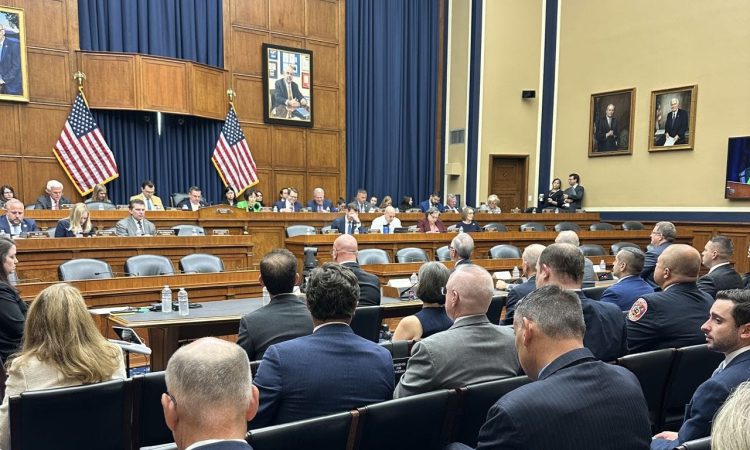
“With FirstNet’s statutory authority set to expire in 2027, it’s time for Congress to assess the progress made by FirstNet to ensure the law requirements are being met and it is adequately serving the needs of our public-safety community,” Hudson said during yesterday’s subcommittee meeting, which was webcast.
Rep. Darren Soto (D-Fla.) talked about the possibility that Congress “could reauthorize FirstNet with potential improvements and reforms,” while Rep. Bob Latta (R-Ohio) described FirstNet as a “true public-private partnership [that] has been tremendously successful.”
Beltway sources have told IWCE’s Urgent Communications that they believe the FirstNet Authority reauthorization will happen, but there have been varied opinions on when it would occur and what changes—if any—could be introduced.
Testimony before the Communications and Technology subcommittee of the House Committee on Energy and Commerce largely reflected this sentiment. All witnesses noted the key role FirstNet has played in public safety’s broadband evolution but also acknowledged that their agencies also use other communications to ensure first responders can pursue their missions.
San Bernardino County (Calif.) Sheriff Shannon Dicus—also representing the Major County Sheriffs of America—said he believes it is important that the FirstNet system continue being built out to address “gaps” but noted that the FirstNet Authority model makes the nationwide public-safety broadband network (NPSBN) unique in the marketplace.
“When you talk about governance and the way FirstNet is rolled out, for the first time, law enforcement and the professionals who are using that [network] are a part of those groups, in terms of implementation of across the country—certainly in our state and locally,” Dicus said. “So, it gives us a voice we haven’t had before.
“More importantly, for all of you [in Congress], it allows you to hear how this affects us, what’s going on in the street, and how we use that technology to better serve the public.”
In his prepared testimony, Dicus said the Major County Sheriffs of America are asking Congress to “remove the sunset provision on the FirstNet Authority.”
Chatham County (N.C.) Emergency Management’s emergency-management director, Steve Newton said he did not know what the appropriate timeframe for a subsequent reauthorization should be. However, Newton noted that his agency uses FirstNet—including owning its own Compact Rapid Deployable (CRD)—while utilizing various technologies, offerings from other carriers, and low-Earth-orbit (LEO) satellite connectivity to provide as many layers of communications resiliency as possible to support the public-safety mission.
Such technologies played a key role in helping the state of North Carolina recover last year during the aftermath of Hurricane Helene, which caused outages to many terrestrial communications networks, according to Newton.
“I had never been a huge proponent low-Earth-orbit satellite systems,” Newton said. “I now own at least six, because of that event.”
Former CEO of the National Emergency Number Association (NENA), Brian Fontes said he was “not here to say that the [FirstNet] network should be sunsetted” but advised lawmakers to consider measures that could help address some of the shortcomings cited by federal oversight officials in recent years.
“What I do believe, however, is when you’re considering the reauthorization of FirstNet that you look at all of the issues identified by Inspector General’s reports regarding the Authority’s oversight,” Fontes said during the subcommittee hearing, which was webcast.
“I also believe we’re now in a world of competition in public-safety broadband networks. We didn’t have that in 2012. We have companies like Verizon, T-Mobile or others coming online that provide opportunities for public safety to utilize broadband networks. I believe public safety is best served when they are in control, and they are capable of making decisions about what network best serves them.”
Much of the discussion during the subcommittee hearing was focused on next-generation 911 (NG911) deployments and the need for federal funding to support the technological transition from legacy 911 platforms. Testimony about this topic will be the subject of a separate article on IWCE’s Urgent Communications.