
By Valentin Grille
In the race to deploy submarine cables, Google has a head start with Equiano, while Meta and its 2Africa consortium are now aiming for a connection in 2024. This dual infrastructure greatly benefits the continent.
Sidi Krir in Egypt, Genoa in Italy, Djibouti and Berbera in Somalia: 2Africa, launched by Meta and eight partners (including Orange, MTN, China Mobile and Vodafone), has only reached four cities to date. This is still not much for a 45,000km monster that aims to circle Africa by 2023. Its completion was recently pushed back to 2024, according to Paul Gabla, vice-president of Alcatel Marine Networks and 2Africa (as well as Equiano) supplier. Meanwhile, the start of operations for Equiano (from Google), which runs along the continent’s west coast, was made official at the beginning of September, a month after it arrived in Cape Town, South Africa.
The reason there is such a gap in progress between their projects is that the two giants have chosen different strategies. “2Africa is a consortium, while Google is building this cable for itself,” says CTO of DE-CIX, one of the world’s leading internet exchange point providers, Thomas King. Meta has opted for an agreement with several operators, each of which will take fibre optic “pairs” in the cable, thus mechanically lowering its initial investment, which is estimated at US$1bn. Google, on the other hand, chose to lay the cable alone and then negotiate with each country: Namibia, South Africa and Nigeria, the only stages planned in advance. “This is not the traditional model because not all pairs are subscribed. The initial reason was that we had to move quickly,” says Gabla.
Redundancy
However, this advance may not constitute a decisive advantage. “The timing is unrelated to the commercial prospects: it was known and the customers are different,” says Gabla. Cables are also expected to take time to deliver their full potential, as demand is yet to be built. A report by Africa Practice and Genesis Analytics estimated in 2021 that Nigeria and South Africa would use only 3 per cent of Equiano’s capacity in the two countries at launch, rising to 10.5 per cent by 2025. “The deployment model for submarine systems is never based on full capacity activation from day one,” says vice president of WIOCC (West Indian Ocean Cable Company), a stakeholder in the 2Africa consortium, Mike Last.
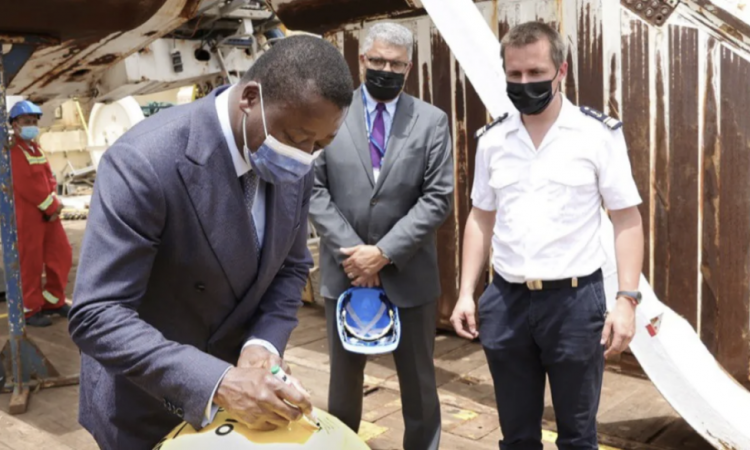
Furthermore, an Internet connection’s viability is based on redundancy. This means that it will be possible, in the event of a cut, to maintain traffic, which presupposes two equivalent connection capacities. Togo, which will benefit from Equiano as soon as it is launched, is negotiating with Meta to link up with 2Africa. “All countries must have access to a second modern system to secure the first,” says Gabla. “Otherwise, the protection will not be complete, as the capacity is no longer sufficiently available on the old African systems.” Equiano and 2Africa, despite the hype, could turn out to be inseparable.
We believe that Africa is poorly represented, and badly under-estimated. Beyond the vast opportunity manifest in African markets, we highlight people who make a difference; leaders turning the tide, youth driving change, and an indefatigable business community. That is what we believe will change the continent, and that is what we report on. With hard-hitting investigations, innovative analysis and deep dives into countries and sectors, The Africa Report delivers the insight you need.