
By Angela Y. Kung and Christen B’Anca Glenn, Mintz
The real winners of the 5G era will be the service providers who can transform their core networks to take full advantage of what 5G Standalone (SA) and cloud-native technologies can offer. While many operators will start their 5G journey with 5G non-Standalone, to fulfill the true promise of 5G, a 5G SA is needed. With many different routes to take when transforming, a trusted source of information and direction is vital for operators. Published today, the latest version of Ericsson’s cloud-native 5G Core network guides series holds the collected insights and learnings gained from years of transforming networks, together with the insights from Ericsson customers who have already launched their 5G Core networks for 5G SA services.
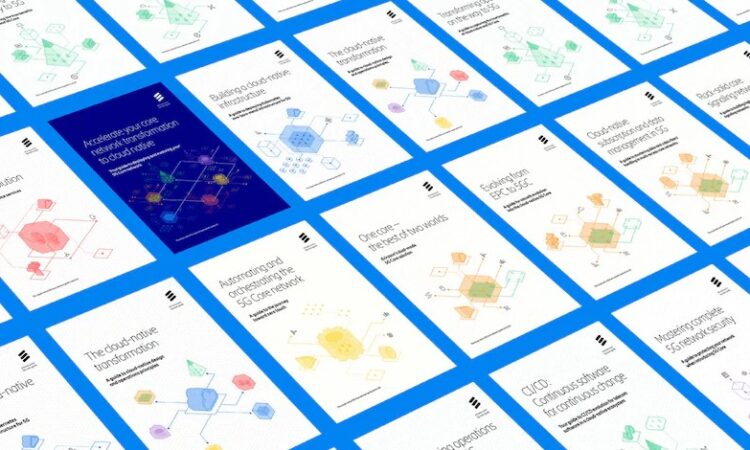
Covers of the full guide series
Originally released in 2020, this guide series covers network technologies and operational aspects of the cloud-native core network in six strategic domains that Ericsson has found to be crucial for service providers to address in order to reach the full potential of their 5G networks. These are: cloud native infrastructure, 5G Core, 5G voice, automation and orchestration, operations and life cycle management, and network security.
Many things have happened since the series was initially published. Our solutions have evolved and, together with leading 5G service providers, we have switched on and optimized dozens of cloud-native 5G Core networks worldwide. This has allowed us to gain more expertise and experience with these new technologies than any other vendor. With this release 2.0 of our guide series, we have compiled the learnings, insights and recommendations for every step of the transformation journey we want to share with all service providers. Whether they are at the beginning of their journey, or considering how to expand, evolve, or more efficiently operate their new core network, this series is here to help service providers to extract the most value from cloud-native 5G Core and 5G SA technologies.
From those six strategic domains, Ericsson has identified five key insights for service providers:
Cloud-native transformation is a catalyst for business transformation. Leading service providers make it clear they view the transformation to cloud-native as a driver for the modernization of the rest of their business. The company’s ability to bring new products and solutions to market faster should be regarded as being of equal importance to the network investment.
Clear strategy and planning for cloud-native transformation is paramount. Each individual service provider’s cloud-native transformation journey is different and should be planned accordingly. The common theme is that the complexity of transforming at this scale needs to be recognized, and must not be underestimated. For maximum short-and-long-term impact tailored, effective migration strategies need to be in place in advance. This ensures that investment and execution in this area forms a valuable element of an overall transformation strategy and plan.
Frontrunners will establish first-mover advantage. Time should be a key factor in driving the plans and strategies for change. Those who start this journey early will be leading the field when they’re able to deploy new functionalities and services. A common frontrunner approach is to start with a greenfield 5G Core deployment to try out ideas and concepts without disrupting the existing network. Additionally, evolving the network will be a dynamic process, and it is crucial to bring application developers and solution vendors into the ecosystem as early as possible to start seeing faster, smoother innovation.
Major potential for architecture simplifications. The standardization of 5G Core has been based on architecture and learnings from IT. The telecom stack should be simplified by incorporating cloud native principles into it – for example separating the lifecycle management of the network functions from that of the underlying Kubernetes infrastructure. While any transformation needs to balance both new and legacy technologies, there are clear opportunities to simplify the network and operations further by smart investment decisions in three major areas. These are: simplified core application architecture (through dual-mode 5G Core architecture); simplified cloud-native infrastructure stack (through Kubernetes over bare-metal cloud infrastructure architecture); and Automation stack.
Readiness to automate, operate and lifecycle manage the new platform must be accelerated. Processes requiring manual intervention will not be sufficient for the levels of service expected of cloud-native 5G Core. Network automation and continuous integration and deployment (CI/CD) of software will be crucial to launch services with agility or to add new networks capabilities in line with advancing business needs. Ericsson’s customer project experience repeatedly shows us another important aspect of this area of change, telling us that the evolution to cloud-native is more than a knowledge jump or a technological upgrade – it is also a mindset change. The best platform components will not deliver their full potential if teams are not ready to use them.
Head of Solution Area Core Networks, Ericsson Monica Zethzon says: “The time is now. Service providers need to get ready for the cloud-native transformation that will enable them to reach the full potential of 5G and drive innovation, shaping the future of industries and society. We are proud to be at the forefront of this transformation together with our leading 5G service providers partners. With this guide series we want to share our knowledge and experiences with every service provider in the world to help them preparing for their successful journeys into 5G.”
The next-generation of wireless technologies – known as 5G – is expected to revolutionize business and consumer connectivity, offering network speeds that are up to 100 times faster than 4G LTE, reducing latency to nearly zero, and allowing networks to handle 100 times the number of connected devices, enabling the “Internet of Things.” Leading policymakers – federal regulators and legislators – are making it a top priority to ensure that the wireless industry has the tools it needs to maintain US leadership in commercial 5G deployments. This blog provides monthly updates on FCC actions and Congressional efforts to win the race to 5G.
Regulatory Actions and Initiatives
Spectrum
The FCC grants the first licenses from its most recent auction of mid-band spectrum in the 2.5 GHz band.
On December 1, 2022, the FCC’s Wireless Telecommunications Bureau (“WTB”) released a Public Notice announcing the grant of 51 long-form applications for 650 licenses to operate in the 2.5 GHz band. A list of the granted applications, sorted by licensee name, is available here, and a list of the applications, sorted by market, is available here.
The FCC takes several actions to grant relief to entities administering shared use of spectrum in the 3.5 GHz band in the wake of Hurricane Nicole and reminds satellite operators to update their registrations for protection from commercial wireless services.
On November 9, 2022, the WTB released an Order conditionally granting Federated Wireless’s request for an emergency waiver of the rules that require Environmental Sensing Capabilities (“ESCs”) in Dynamic Protection Areas (“DPAs”) to detect and protect federal incumbent users in the 3.5 GHz band from harmful interference. Tropical Storm Nicole, which later became a hurricane before making landfall in Florida, was expected to cause widespread power outages that could cause DPAs 14, 15, 16, and 17 to be activated, potentially disconnecting thousands of customers from broadband, voice, and data services. Grant of the waiver enabled Federated Wireless to treat the subject DPAs as “inactive” for the duration of the waiver authority, relieving its ESC of the detection requirement.
Similarly, on November 10, 2022, the WTB released an Order conditionally granting Federated Wireless’s, Google’s, and CommScope’s request for an emergency waiver of DPAs East 14 and East 15 in Florida. Because the trajectory of the storm shifted since Federated Wireless submitted its initial waiver request (see above), it also sought a waiver for DPA East 13. Grant of the waiver enabled Federated Wireless, Google, and CommScope to treat the subject DPAs as “inactive” for the duration of the waiver authority, relieving its ESC of the detection requirement.
On November 21, 2022, the WTB, Office of Engineering and Technology, and International Bureau released a Public Notice reminding operators of grandfathered Fixed Satellite Service earth stations entitled to protection from Citizens Broadband Radio Service users in the 3.5 GHz band – including those in the 3.6-3.7 GHz band and telemetry, tracking, and control stations in the C-band (see also below) – of their annual December 1 registration requirement. After January 1, 2023, registrations that have not been completed may be deactivated or deleted, and the sites will no longer merit protection by the Spectrum Access System administrators.
The FCC announces the search committee that will select a Reimbursement Clearinghouse for the relocation of incumbents in the 3.45 GHz band so that it may be made available for commercial wireless use.
On November 10, 2022, the WTB released an Order identifying the four entities – NBCUniversal, Nexstar Broadcasting, CTIA, and the Competitive Carriers Association – that will form a search committee to select a Reimbursement Clearinghouse (“Clearinghouse”) for the relocation of, and reimbursement to, non-federal radiolocation licensees from the 3.45 GHz band so that it may be made available for commercial wireless services. In addition, the WTB adopted certain requirements regarding the Clearinghouse search committee selection process and the operation of the Clearinghouse, which will include reviewing cost estimates from incumbents, apportioning those costs and collecting them from new wireless licensees, and disbursing those funds. Unlike other proceedings that utilized a relocation clearinghouse, the Clearinghouse will not be tasked with resolving disputes. That function will remain with the WTB. The search committee must notify the WTB of its tentative choice for the Clearinghouse by May 2, 2023.
The FCC seeks to update its list of incumbent earth stations operating in the C-band, which is being cleared for commercial 5G services.
On November 18, 2022, the FCC’s International Bureau released a Public Notice with an updated list of earth stations that have been reported by RSM US LLP, the C-band Relocation Coordinator, as non-operational, over-registered, or not receiving in the C-band. Earth station operators included in the list have 90 days – i.e., until February 16, 2023 – to correct their registrations or affirm that their earth stations are in operation and receive in the C-band. Failure to do so will result in the automatic termination of the operator’s earth station authorization or a determination that the antenna does not qualify for incumbent status (and thus interference protection).
Other Agency Actions
The FAA seeks additional protections for altimeters operating in the C-band from 5G wireless operations.
On October 21, 2022, the Federal Aviation Administration (“FAA”) reportedly requested that the FCC mandate on all licensees operating in the 3700-3980 MHz portion of the C-band the 5G interference mitigation techniques to which AT&T and Verizon voluntarily agreed in June to protect radio altimeters operating in the adjacent 4200-4400 MHz band. The mitigation techniques stem from negotiations the parties had with the FAA in January, which will purportedly protect aviation operations and ensure safe landings at airports where 5G is operating. The FAA’s request has not yet been made publicly available.
The aviation industry has also reportedly asked the Biden Administration to extend those 5G mitigation techniques and for the FAA to release its request to the public.
Legislative Efforts
Members of Congress urge the FCC to stop consideration of the 1675-1680 MHz band for commercial wireless services.
On November 21, 2022, leaders of the House Science, Space and Technology Committee sent a series of letters to all FCC Commissioners urging the FCC to drop its consideration of allowing wireless carriers to use the 1675-1680 MHz band on a shared basis with federal users for commercial wireless services. They explain that the 1675-1680 MHz band is critical to the National Oceanic and Atmospheric Administration’s (“NOAA”) collection and dissemination of real-time weather data. The letters follow the release of a report from NOAA in September, which found that there is a significant risk of harmful interference for some systems if the spectrum is shared, but, given time, NOAA may be able to establish sufficient redundancy and alternative means of distributing key data to preserve its ability to carry out its critical missions.
The content of this article is intended to provide a general guide to the subject matter. Specialist advice should be sought about your specific circumstances.