
By Bojana Vlajcic
The European Bank for Reconstruction and Development (EBRD) is helping to speed up Croatia’s transition to clean energy by helping to finance the construction of two new wind farms.
The bank is extending a €43 million(US$43.73million) loan to Kunovac d.o.o., a limited liability company jointly owned by Taaleri Energia’s SolarWind II Funds and ENCRO Kunovac d.o.o., for the first utility-scale renewable project in Croatia developed outside of a renewables subsidy scheme.
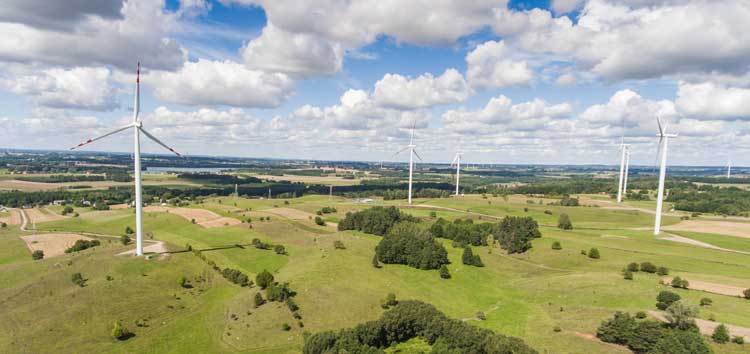
The EBRD proceeds will finance the construction and operation of two onshore windfarms in the Zadar region, with a joint total grid capacity of 111MW, enough to power 85,000 households. They will also help to avoid more than 78,000 tonnes of CO2 emissions annually and are expected to increase the country’s current electricity generation from renewable sources (excluding large hydro) by around 10 per cent. The EBRD financing will be complemented by parallel loans from Zagrebacka Banka d,d. and the Croatian Bank for Reconstruction and Development for a total debt financing package of €126 million.
This is the EBRD’s first wind-farm investment in Croatia. Moreover, it showcases a novel financing structure in the country, combining a corporate power purchase agreement and merchant-based financing structure.
The investment will allow Croatia to make progress towards its 2030 environmental targets and COP26 commitments, which envisage an increase in the share of electricity generation from wind and solar from 14 per cent in 2020 to 27 per cent in 2030 and 45 per cent by 2050.
EBRD Director, Head of Energy for Europe Grzegorz Zielinski said: “We are delighted at the opportunity to support this investment, which will secure more clean energy for the citizens of Croatia. The EBRD has always been at the forefront of supporting innovative and bold investments and we are pleased to support this project, which is among the first outside a subsidy scheme and is introducing new ways of structuring and financing renewable projects, not only in Croatia but also in other countries where the Bank operates.”
Managing Director of Taaleri Energia, Kai Rintala said: “Taaleri Energia is pleased to be making a contribution to the further growth of renewable energy generation capacity in Croatia. This investment is being realised thanks to the close collaboration and efforts of a number of our key partners, including the EBRD. We look forward to building upon this first investment in Croatia in the coming months and years.”
CEO and owner of ENCRO, Iljko Ćurić said: “With this latest project, ENCRO is continuing to unlock Croatia’s renewable energy potential. This project contributes to Croatian and EU energy transition targets and strengthens economic growth, security and climate action, and will help Croatia fulfil the requirements of the EU’s Recovery and Resilience Facility (connection to the grid of 1.5 GW of renewable energy sources by 2025). This project is being realised during an unprecedented European energy crisis and it will reduce Europe and Croatia’s dependency on energy imports.”
The EBRD has already supported two Taaleri Energia fund investments in wind farms in Poland and Serbia.
Part of Helsinki-listed Taaleri Group, Taaleri Energia is a renewable energy developer and fund manager. The company has one of the largest dedicated wind and solar investment teams in Europe and a 2.8 GW wind and solar portfolio in Europe, the US and the Middle East. Taaleri SolarWind II fund is its fifth and most recent private equity fund focusing on renewables.
The EBRD is a leading institutional investor in Croatia. The Bank has invested more than €4 billion in the country to date. Its focus there is on supporting private-sector competitiveness, developing capital markets and promoting the commercialisation of public companies. Its investments are combined with support for policies that promote a more enabling business environment.
The WA government has signed a memorandum of understanding (MOU) with INSEAD business school to promote the state’s innovation capability.
The New Industries Fund will partner with the leading business school for the development of a new West Australian case study as part of INSEAD’s Master of Business Administration program
Two INSEAD student teams will provide a report on their findings of the WA innovation ecosystem, contributing to the WA government’s innovation policy framework.
A virtual reality case study based on a WA-based mining operation will be developed in collaboration with the mining industry as part of the program, to highlight virtual business environments and support automation and robotics in mining along with autonomous vehicle usage.
This will be welcome news to WA’s resources sector. According to peak body The Chamber of Minerals and Energy, the sector may need up to 40,000 additional workers by the end of 2023. Innovation has historically been a boon for WA mining, with innovations in remote work and automation improving profitability and workers’ wellbeing.
Innovation and ICT minister Stephen Dawson said the MOU is an important stepping stone to showcase the state’s innovation capability, including “facilitating case studies that will promote our mining technology to the world.”
“We are proud to be the first jurisdiction in Australia to partner with the internationally acclaimed INSEAD business school,” he said.
“The McGowan government is committed to supporting our local innovators through these kinds of partnerships, which help drive the diversification of our economy and create the jobs of the future for Western Australians.”
The New Industries Fund is a US$16.7 million commitment that seeks to support business innovation in Western Australia.
INSEAD is a leading non-profit business school, and 6th in the QS World University Rankings Global MBA Rankings.