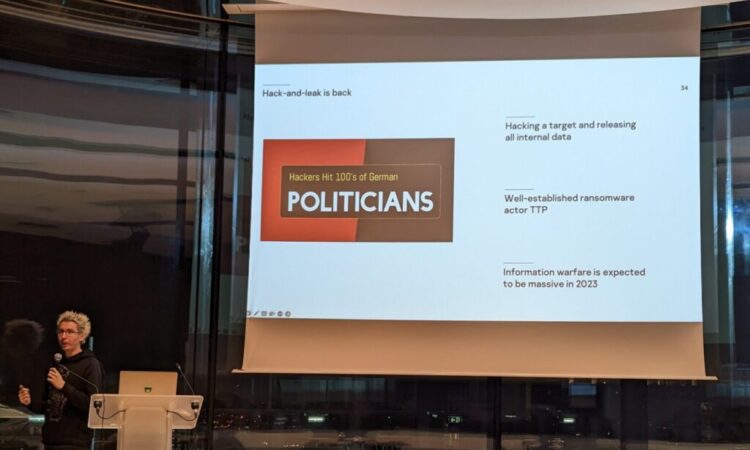

During a press conference, a Kaspersky security researcher shared with us his predictions for the coming year regarding the most sophisticated cyber threats. And it’s chilling.
Attacks on hospitals and institutions, multiplication of ransomware, hacking of critical infrastructures and companies such as Uber or Rockstar Games… The year that is ending has been the scene of an explosion of serious cyber threats. Bad news: you haven’t seen anything yet.
On the occasion of its 25th anniversary, Kaspersky organized a conference at its Paris premises to present its new products to the press. But the Russian cybersecurity giant also took the opportunity to try its hand at the difficult foresight exercise it undertakes each year: what new threats should we expect for 2023?
Result of the work of security researchers from its GReAT laboratory (Global Research and Analysis Team), this study, presented by Ivan Kwiatkowski, a “senior” researcher at GreAT and a specialist in the most sophisticated threats, has something to send shivers down the spine. “Destructive” attacks, siphoning of mail servers, data theft by states and hacking by drones… here is a brief summary of the “cyber” threats that may await us tomorrow.
Even more “destructive” attacks
“We can expect to see unprecedented gravity attacks in 2023, more specifically disruptive and destructive attacks” launches Ivan Kwiatkowski to put us in the mood. In question ? The particularly tense geopolitical context between “ the Western bloc and the Eastern bloc”. The war in Ukraine also has consequences for cyberspace. We remember, for example, that shortly after the start of the conflict, an attack managed to damage thousands of satellite communication terminals to render them inoperative. More recently, the European Parliament suffered a major denial of service attack after passing a resolution declaring Russia to be a “State sponsor of terrorism”.
Things could therefore, according to Kaspersky, become much worse in 2023. Sabotage of civil infrastructure sites or industrial sites – possibly disguised as an accident – could occur, as could the destruction of submarine cables, equipment as strategic as it is difficult to protect. ” Since the destruction of the Nord Stream gas pipeline, we know that there are some capabilities to destroy this kind of underwater equipment says Ivan Kwiatkowski.
Mail servers in the crosshairs
This is a “weak link” that Kaspersky recommends monitoring very closely this year: mail servers, and in particular shoppingmode Microsoft Exchange and Zimbra, which have already been victims of several critical vulnerabilities this year. “These software suites have the difficult task of having to protect confidential data – all of an organization’s emails – while exposing a huge attack surface on the Internet” summarizes Ivan Kwiatkowski. The researcher relies on in-depth research of cybercriminals or state hackers in an attempt to penetrate them. With consequences that could be catastrophic, of course: theft of authentication data, theft of sensitive information, etc.