
If European leaders do not want to confront Russian forces on NATO territory, they will have to do so in Ukraine, even without US backing. That is the conclusion of a new policy brief ‘Can Europe save Ukraine – and itself – from Putin and Trump?’ By IAN BOND.
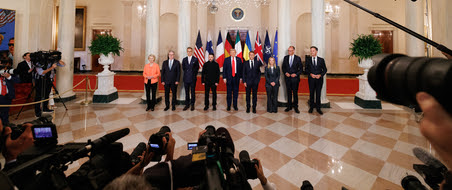
Western leaders have tried to portray the events of the last month, with Trump’s summit with Putin in Alaska, his White House meeting with Zelenskyy and European leaders and the Coalition of the Willing meeting in Paris, as steps towards a peace deal between Russia and Ukraine that would allow European peacekeepers, with US backing, to deploy to Ukraine to provide a security guarantee. This attractive vision is a fantasy. Europeans need to face up to four key facts:
Trump favours Putin over Zelenskyy. The US is now doing relatively little to help Ukraine. That is contributing to Ukraine being on the back foot on the battlefield. Meanwhile, its cities are under nightly attack.
The Russians will not agree to Ukraine having any effective protection against future attacks, and the US is reluctant to provide an insurance policy for European forces in Ukraine.
Putin remains determined to win, not compromise. His peace terms would reduce Ukraine to vassal status.
Trump has repeatedly threatened further sanctions on Russia, but has not carried out his threats. Putin feels confident that he will face no consequences for continuing the war.
Most European leaders have not begun to explain to their populations what is at stake if Ukraine is defeated. To avoid that outcome, they need to pursue two challenging objectives:
Stabilising the front and ideally pushing Russia back. Europe should help Ukraine capitalise on its campaign of hitting critical targets in the Russian rear, including oil refineries.
Providing credible, effective and sustainable security guarantees. The Coalition of the Willing should ally itself with Ukraine to provide mutual defence in the face of a growing Russian threat to Europe. Ukrainian forces would be at the heart of the new alliance, with France and the UK providing a nuclear deterrent.
Commenting on his conclusion, Ian Bond said: “Putin has spent years militarising the Russian economy and Russian society. He is not going to stop fighting as long as he thinks he has a chance of eliminating Ukraine from the map.
But his ambitions don’t stop there: he and those around him have questioned the statehood of the Baltic states and Poland. So, are European leaders willing to subordinate themselves to Moscow, and, if they are not, are they going to fight alongside Ukrainians in Ukraine to defeat Russia, or wait till Ukraine has been defeated and then fight Putin’s forces on NATO territory?
No sane person wants a war in Europe, but Putin has already launched the war, and Europe’s democracies cannot afford to lose it.”
- Bond is deputy director of the Centre for European Reform.