
By Stephen Withers
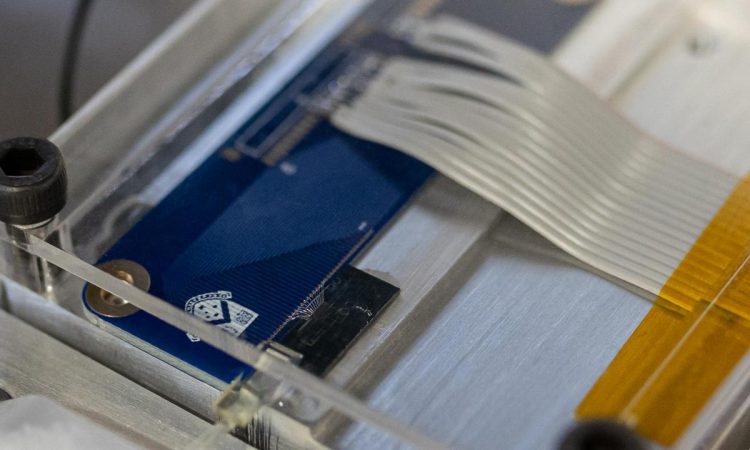
Research led by Monash and RMIT Universities in Melbourne has found a way to replace bulky 3D optics with a silicon chip.
“We have demonstrated a self-calibrating programmable photonic filter chip, featuring a signal processing core and an integrated reference path for self-calibration,” explained lead investigator Monash University ARC laureate fellow Professor Arthur Lowery.
“Self-calibration is significant because it makes tuneable photonic integrated circuits useful in the real world; applications include optical communications systems that switch signals to destinations based on their colour, very fast computations of similarity (correlators), scientific instrumentation for chemical or biological analysis, and even astronomy.
“Electronics saw similar improvements in the stability of radio filters using digital techniques, that led to many mobiles being able to share the same chunk of spectrum: our optical chips have similar architectures, but can operate on signals with Terahertz bandwidths.”
The researchers say applications include AI for driverless cars, medical diagnostics and natural language processing, plus smaller switches for reconfiguring optical networks
The approach was conceived by Dr Mike Xu from Monash University’s Department of Electrical and Computer Systems Engineering and now at Beijing University of Posts and Telecommunications, Professor Arthur Lowery from Monash University’s Department of Electrical and Computer Systems Engineering, and Dr Andy Boes from RMIT and now at the University of Adelaide.
Professor Arnan Mitchell and Dr Guanghui Ren engineered the chip, and the project was funded by the Australian Research Council.
While photonic circuits manipulate and route optical channels of information, they can also provide some computational ability, for example, searching for patterns, something this is fundamental to many applications including medical diagnosis and internet security.
Traditional photonic chips have to be manufactured to nanometre tolerances – a difficult and expensive process – but self-calibration overcomes this problem.
“Our solution is to calibrate the chips after manufacturing, to tune them up in effect by using an on-chip reference, rather than by using external equipment,” said Lowery.
“We use the beauty of causality, effect following cause, which dictates that the optical delays of the paths through the chip can be uniquely deduced from the intensity versus wavelength, which is far easier to measure than precise time delays. We have added a strong reference path to our chip and calibrated it. This gives us all the settings required to ‘dial up’ and desired switching function or spectral response.”
This approach opens up other applications, including optical correlators that can almost instantaneously find patterns of data in data streams, such as images, and this is something the group has also been working on.
“As we integrate more and more pieces of bench-sized equipment onto fingernail-sized chips, it becomes more and more difficult to get them all working together to achieve the speed and function they did when they were bigger. We overcame this challenge by creating a chip that was clever enough to calibrate itself so all the components could act at the speed they needed to in unison,” said Boes.
The self-calibrated chip is said to complement the optical microcomb chip – also developed at Monash University and RMIT – that achieved the world’s fastest internet speed from a single fingernail-sized chip.
“This research is a major breakthrough – our photonic technology is now sufficiently advanced so that truly complex systems can be integrated on a single chip. The idea that a device can have an on-chip reference system that allows all its components to work as one, is a technological breakthrough that will allow us to address bottleneck internet issues by rapidly reconfiguring the optical networks that carry our internet to get data where it’s needed the most,” said Mitchell.