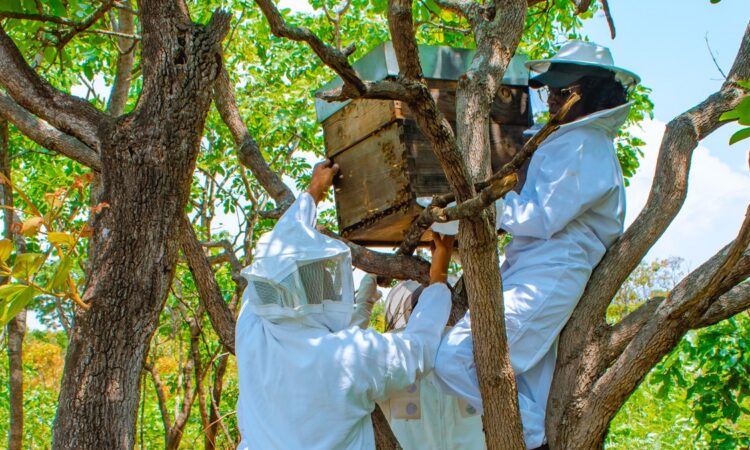

An UNCTAD project is harnessing the power of bees to help women improve their livelihoods while creating sustainable opportunities in rural communities in the southern African nation.
Mavilde de Assunção Alves has been a beekeeper for almost 15 years. Every week she sets up a table to sell honey on the main road or at the local market in Bailundo, a town in Angola’s central Huambo province.
“I have many customers,” she says with a smile, although she admits that the work is challenging.
Like most beekeepers in Angola, Ms. Alves walks many kilometres to tend to her hives dotted across the hilly landscape of her 45 hectares of farmland, where she also grows corn, beans, potatoes and other crops.
Each hive, made by hollowing out tree trunks, produces six to eight kilos of honey, which she collects by using smoke to calm and distract the bees while she gathers their honey in a bowl.
Some of it is enjoyed by her family while the rest is sold to help make ends meet in one of the county’s poorest provinces.
Over the years, the 57-year-old has struggled to maintain the hives, which have dwindled from 15 to eight. Working without protective equipment, she’s often stung and now suffers from joint inflammation and pain.
But after attending a training workshop organied by UNCTAD and the Universidade José Eduardo dos Santos, she’s more confident about the future.
Ms. Alves is one of seven women trained through an UNCTAD project that is working with the government, researchers, farmers and businesses to harness the untapped potential of honey in the country.
The project is a component of a European Union-funded programme to support Angola’s efforts to diversify its oil-driven economy. According to recent estimates, oil accounts for more than 90 per cent of the country’s exports.
A study conducted by UNCTAD and national stakeholders identified honey as a promising “green” product that could help diversify exports while minimizing environmental impacts and creating new economic opportunities in rural communities.
Although Angola only produces around 90 tons of honey a year, UNCTAD estimates show this could increase to 200 tonnes with improved production methods.
“Angola is a country with great potential to produce high-quality honey,” says Teresa Moreira, officer-in-charge of UNCTAD’s international trade division.
“The country has a diverse range of flora, including several species of flowering plants that provide abundant nectar and pollen for bees. And its warm and humid climate is ideal for beekeeping.”
But to realize its potential, the country needs to modernize the techniques and equipment of beekeepers like Ms. Alves, help them improve the quality of their honey to meet international standards, and give them better access to buyers and infrastructure for processing and transporting their products.
While working with the various actors in the honey sector to improve production methods, UNCTAD has particularly focused on how the project can empower women.
“In Angola, beekeeping has traditionally been seen as an activity for men,” says one of UNCTAD’s lead trainers for the project, Marisa Rodrigues. “Training women as beekeepers helps to uplift their skills while diversifying and renewing the industry.”
“Beekeeping can give women a sense of empowerment and independence as they take on leadership roles in their communities,” says Ms. Rodrigues.
Protecting the environment while boosting incomes
By learning to care for bees, women farmers are helping to protect the environment and boost food security. About a third of the world’s food production depends on pollinators such as bees, according to the UN’s Food and Agriculture Organization.
And healthier bees produce more and better honey, which increases beekeepers’ incomes and improves their families’ livelihoods.
Another participant, Júlia Nangueve, says the training workshop helped her see how a few small improvements make a big difference.
“We learned not to sell our honey on the street,” she says. “It’s better to sell it at the farm or in a covered area so that the honey doesn’t spoil. Also, if smoke is used then there is a smell, and the honey loses value.”
Ms. Alves credits the workshop with helping her better understand when honey can be produced in her region. Previously, she had only produced honey between October and February – missing out on the secondary production season, typically between April and June.
Although the secondary season is typically less productive, it can still significantly increase her income.
Besides modern beekeeping techniques, the training also covered forest conservation, honey quality control, and other opportunities in the sector, such as making beeswax or beekeeper’s suits.
Bringing others on board
Ms. Alves and Ms. Nangueve are the president and vice-president of the Katiavala Agricultural Cooperative, which has 45 women and six men as registered members.
Only some of the members are also beekeepers, but after the training workshop, Ms. Alves and Ms. Nangueve are on a mission to get more people on board.
As trained trainers, they’ll transmit their newly acquired beekeeping knowledge and skills to other members of the community.
“My dream is to spread the knowledge and increase honey production,” Ms. Alves says.
UNCTAD will work with national stakeholders to produce a guide of best practices based on the experiences of project participants.
World in crisis demands protection of consumer rights to water and energy
Multiple global crises are threatening access to essential services for the most disadvantaged consumers. UNCTAD outlines the actions needed to safeguard their rights.
Equitable access to water and energy is a basic human right, but there’s much more to do to make it a reality.
To mark World Consumers Rights Day on 15 March, UNCTAD convened an expert meeting to explore how countries can better defend the rights of all consumers – particularly the most vulnerable – to these essential services.
The UN estimates that at the current pace of progress, 1.6 billion people could still lack safe drinking water by 2030.
Meanwhile, years of rising energy costs – further aggravated by the war in Ukraine – risk pricing out consumers in poorer communities across more than 90 developing countries.
“Let us enjoy the water and energy we will consume today, and solemnly remember the millions who do not share the same luck, and for whom we must spare no efforts,” UNCTAD Deputy Secretary-General Pedro Manuel Moreno said at the meeting.
Prioritizing access, rationalizing subsidy
Ensuring consumers’ access to essential services is a first and key step, said legal director of Ghana’s public utilities regulatory commission, Nancy Atiemo.
“We are constantly reassessing our policy frameworks to ensure more consumers can access public utilities,” Ms. Atiemo added, “It means improving connectivity, affordability and the quality of service.”
To expand access, one traditional approach is offering blanket subsidies.
But this tends to favour the better-off, as existing water and energy subsidies in developing countries often take the form of below-cost tariffs that exclude the non-connected poor, who pay high prices for off-network services such as bottled water and firewood.
Experts say connectivity matters more than tariffs when it comes to ensuring water and energy access for all. Therefore, subsidies should instead focus on connecting off-grid populations.
“Tariff subsidies are more justifiable when networks are complete. When they’re not, connection subsidies are more effective,” said an expert who contributed to a recent UNCTAD report on consumer access to essential services, Robin Simpson.
Vital need for sustainability
Boluwaji Onabolu, who heads a Nigerian NGO advancing water, sanitation and hygiene causes, floats a social sustainability model that involves and empowers consumers – especially those living in remote areas – at the same time.
The model underscores leveraging the potential wealth of consumers’ knowledge and skills in the management of water supply and sanitation projects.
“Inclusion by empowerment of consumers, for example, in operation and maintenance of water services is vital for sustainability and value for money,” Ms. Onabolu said.
The meeting also called for more responsible use of water and energy, given Earth’s finite resources.
Experts caution that demand reduction through efficiency has been underestimated, and may require existing utility services to change their business model – away from dependence on energy sales towards energy efficiency based on least-cost planning.
Policy recommendations from UNCTAD
“Realizing consumers’ basic right to water and energy requires more than a formal legal declaration,” said head of competition and consumer protection at UNCTAD, Teresa Moreira.
As the UN system’s focal point on competition and consumer protection issues, UNCTAD advocates for a policy framework to safeguard consumers’ right to water and energy, making such necessities more accessible and affordable to the most vulnerable.
It urges better protection of consumers in relation to public utilities, by enhancing clarity and fairness of service conditions, non-discriminatory treatment of consumers, service information, dispute resolution and easing of bills payment.
Also, it encourages competition in water and energy markets through rigorous public procurement mechanisms and competitive negotiations.