
The first cohort of scientists graduates from IAEA-backed Master’s Programme in Nutrition and Nuclear Techniques
By Ding Feng and Victor Owino, IAEA Department of Nuclear Sciences and Applications
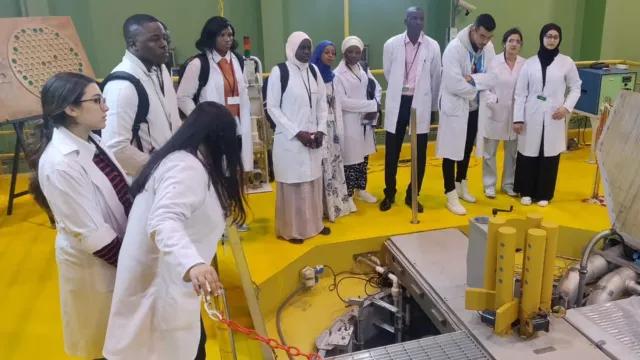
The IAEA’s effort to build long-term nutrition science capacity across Africa has reached a major milestone with the graduation of the first 18 students from the Master’s Programme in Nutrition and Nuclear Techniques. The inaugural cohort is from francophone Africa: 16 completed their studies at the International University of Rabat in Morocco, and two graduated from North-West University in South Africa. The programme transforms regional capacity-building commitments into practical skills that graduates can use to improve nutrition outcomes across the continent.
The graduation of this inaugural cohort has increased Africa’s pool of trained specialists with the skills to generate reliable nutrition data using nuclear techniques — data that provides the basis for objective insights and evidence-based solutions. These 18 scientists are also equipped to share their new knowledge and skills with the next generation of African nutritionists.
Addressing the Nutrition Gap in Africa
Many countries in Africa face a persistent double burden of malnutrition: childhood stunting rates remain high even as diet-related non-communicable diseases rise. A critical shortage of trained nutrition professionals compounds this crisis, limiting the continent’s capacity to navigate threats such as changing food systems, environmental pressures and economic globalization, which limit access to nutritious diets and exacerbate the vicious cycle of malnutrition.
To close this gap, the IAEA’s human health and technical cooperation programmes established the Master of Science in Nutrition and Nuclear Techniques to prepare African scientists to design evidence-based nutrition strategies. Students learn to safely apply stable isotope techniques — minimally invasive and highly accurate diagnostic tools — to assess body composition, energy expenditure, nutrient bioavailability and breast milk intake in infants, and also study epidemiology, statistics and nutrition policy. The two-year curriculum is capped by a field assignment and a thesis based on stable isotope-derived data.
The standardized curriculum, which was developed and validated by health professionals from 22 African countries, in line with the African Union’s Agenda 2063, is so far delivered through four teaching centres: the University of Ghana, the International University of Rabat in Morocco, , North-West University in South Africa and Mukuba Universiy in Zambia. It is also under development at Université Cheikh Anta Diop in Senegal. The first 18 graduates come from 11 countries: Benin, Burkina Faso, Comoros, Ivory Coast, Mali, Mauritania, Morocco, Niger, Rwanda, Senegal and Zimbabwe.
The programme is the result of an eight-year effort. In 2018, the IAEA and the African Union Commission (AUC) signed their first-ever practical arrangements for the peaceful use of nuclear technologies in Africa. The following year, the need for coordinated nutrition capacity-building through a harmonised curriculum in nutrition and nuclear techniques was presented and discussed by the IAEA and the AUC at the 10th Africa Day for Food and Nutrition Security in Cairo. In 2022, experts from selected African universities met in Vienna to draft a curriculum framework and select the teaching centres. The programme was formally validated in 2023 at a regional meeting in Lusaka, Zambia, and launched at the Federation of African Nutrition Societies Conference in Dakar that November, when the first IAEA-sponsored students began their studies.
“Human resource development is a high priority for the African continent,” said Acting Director of the IAEA Division for Africa Gashaw Wolde. “We are proud to have supported the development and implementation of this new Master of Science in Nutrition and Nuclear Techniques, and to see the first graduates return to their home countries equipped with the knowledge, skills and qualifications that will enable them to shape evidence-based nutrition strategies that address the challenges each country faces.”
Individual Testimonies
Nibourou Top, from Senegal, is among the first cohort of graduates from the International University of Rabat. Her research applied stable isotope techniques to assess vitamin A intake in breastfed infants in Dakar. She is now interning with the IAEA’s Nutritional and Health-Related Environmental Studies Section, after which she will pursue a PhD on provitamin A bioavailability from plant-based foods. She hopes to expand the use of stable isotope methods across Africa.
“The Master’s Programme in Nutrition and Nuclear Techniques gave me a scientific identity, alongside the language and tools to contribute meaningfully to international research. It also opened a door that I could never have imagined, working alongside the very experts who helped design the programme that shaped me,” said Nibourou. “I am sincerely grateful to the IAEA for this investment, not just in me, but in an entire generation of African nutrition scientists.”
Pauline Tsikayi, from Zimbabwe, and Phionah Nziza, from Rwanda, are the two graduates from North-West University in South Africa. Pauline’s research addresses the persistently high rates of anaemia and iron deficiency among young African women, using stable iron isotopes to assess iron absorption. Phionah compared the deuterium dilution technique with bioelectrical impedance analysis to improve the accuracy of body composition measurement in African populations.
“Sincere gratitude to the IAEA for this fellowship and their valuable support throughout my master’s journey,” said Phionah Nziza. “This programme has strengthened my capacity to contribute to nutrition research and education and drive evidence-based impact, both in Rwanda and beyond.”
“The IAEA-supported Master’s Programme in Human Nutrition and Nuclear Techniques signifies a major step toward confronting Africa’s dual burden of malnutrition and diet-related non-communicable diseases,” said Director of the IAEA Division of Human Health May Abdel-Wahab,. “The stories of these individuals show that the programme transcends standard capacity building. Instead, it represents a profound, long-term investment that empowers graduates to pioneer localized research, influence evidence-based national policies, and actively train the next generation of scientists who will shape Africa’s public health and nutritional future.”