Motorola Solutions Unveils Combo RSM And Body Cam With Multiple AI Capabilities

Motorola Solutions announces the SVX, a remote speaker microphone (RSM) with a built-in video camera and artificial-intelligence (AI) for enhanced audio, which is key to enabling more accurate transcription of voice communications—and other AI-powered applications in the future—when coupled with the APX NEXT radio
By Donny Jackson, Editor
Motorola Solutions today announced the SVX, a remote speaker microphone (RSM) with a built-in video camera and artificial-intelligence (AI) for enhanced audio, which is key to enabling more accurate transcription of voice communications—and other AI-powered applications in the future—when coupled with the APX NEXT radio.
Motorola Solutions’ vice president of real-time intelligence solutions, Jim Wolfinbarger discussed the significance of the SVX—a name that represents “secure (S), voice and video (V) converged (X), he said—as a way to reduce the number of devices on an officer, as well enabling integration into the company’s Assist AI engine that is part of the CommandCentral Aware platform.
“For me, the lifeline communications—day-to-day—for a frontline [responder] is a radio. Over the past decade plus—since about 2014—a body camera has become a de facto aspect of the uniform,” Wolfinbarger said during an interview with IWCE’s Urgent Communications. “This represents one of the times in which we’re actually taking something off a frontline officer by offering a converged device that accomplishes both [voice and video communications] better than each individually.
“And it’s not just a two-for-one [device]. The operational benefits of the application of AI has been very thoughtfully done in this. I think it’s a real game-changer.”
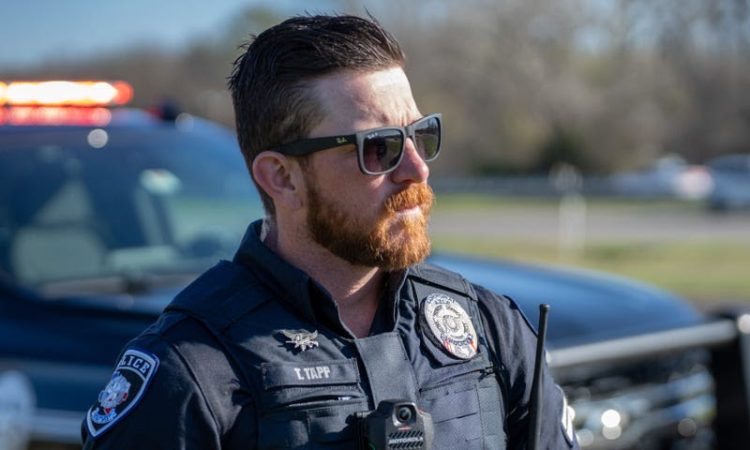
Some AI is built into the SVX (pictured above on the chest of an officer), allowing Motorola Solutions’ existing ViQi AI assistant to response to verbal commands to alter device settings, according to company officials. In addition, the SVX’s built-in AI allows the speaker microphone to provide “voice isolation”—a technology that lets the microphone transmit only spoken words, as opposed to background noise, like sirens—that allows even whispering user voices to be heard.
Motorola Solutions’ vice president of response, reporting & evidence solutions, Jeremiah Nelson said this AI-enhanced audio not only improves comprehension of voice communications via the SVX, but it meets the intelligibility requirements to be leveraged by the cloud-based Assist AI engine that was introduced last year in the 911 space.
“It’s not just that you want to make sure that people hear you. We want to make sure that it’s captured in a way that’s transcribable when it gets into the AI side of the house,” Nelson said during an interview with IWCE’s Urgent Communications. ““If you look at this whole ecosystem, you’re seeing Assist take a front seat in 911, CAD, records and evidence workflow. All of that becomes enabled by the quality of video and audio that comes out of this new converged device [the SVX].
“It’s this device, plus the AI capability, that’s really transformational.”
In particular, the cloud-based Assist AI—something that requires an LTE connection to access—supports real-time transcription and translation services for voice communications in a 911 center. Some of these capabilities—notably, the automatic identification of the language being spoken—will not be enabled via the SVX immediately upon commercial release, but they could be implemented in the device in the future, Nelson said.
Of course, any AI application has to be trained to work optimally in a given environment. Wolfinbarger said Motorola Solutions is particularly well positioned to do this.
“The nice part for Motorola is that we can take the engine from 911—we’re talking about millions, in terms of what’s coming in—and apply that learning to the same modality here,” Wolfinbarger said. “Having that end to end—from call-taking, all the way through the process—[helps compliance with rules regarding] open records.”
One of the most time-consuming tasks required under many open-records regulations is redacting video, which is done to protect the identity of people or sensitive information that might be captured by video surveillance footage that is shared publicly. Nelson said Motorola Solutions’ Assist AI engine can help government personnel complete redactions much more quickly.
“Historically, tools require you to go frame by frame, marking every face [and other items that need to be redacted]—in a video that’s 30 minutes long, it will take you 30 minutes or longer to redact with a lot of tools today,” Nelson said. “What our technology does is it goes through and analyzes the entire video and identifies all of the faces, any documents that might be sensitive, license plates, monitors [that needs to be redacted], and it automatically bounds it all for you.
“What used to take hours to redact now can be done literally in minutes.”
Wolfinbarger, a retired chief for the Colorado State Patrol, said converging the RSM and body-worn camera into a single SVX device that supports real-time streaming is a reflection of the ever-growing importance that video plays in today’s public-safety operations and related ecosystem.
“Initially, I was concerned about body cameras—this was years ago, back 2012, 2013 and 2014—because I was concerned that it might preclude an officer taking control of a situation the way they might need to,” Wolfinbarger said. “But what I’ve found is that most officers—to the 99th percentile—will not give up their body cameras today, because it protects them against accusations that were unfounded, it gives them an objective truth. It gives them a way to go back and verify the veracity of their recollection.
“We’re accelerating that recollection in a way that not only accelerates workflows, but it improves the accuracy of them, too.”
Another key workflow process for law enforcement is the filing of reports, which are important legal documents that chronicle the beginning of most cases. These place a significant amount of legal responsibility on an officer, and AI can help ensure that end-to-end evidence accurately reflects what occurred during a given incident, Wolfinbarger said.
“Once you sign off on that, as a police officer—that affidavit, that warrantless arrest, that narrative—you own it. It doesn’t matter how it was generated, it’s yours,” Wolfinbarger said. “And when you testify in front of a judge and a jury, you own it. There are consequences to not [having an accurate report].
“AI offers this hope and opportunity of accelerating workflows, but it needs to be tempered and grounded in responsible adoption of technology that allows reports to be generated in a way that is defensible, provable and repeatable.”
Nelson said the SVX can be ordered today and is expected to be delivered to customers this summer.