
By Mary Albon, IAEA Office of Public Information and Communication
The IAEA’s flagship Rays of Hope initiative to expand access to cancer care was in the spotlight at this year’s Scientific Forum.
The signature side event at the 70th IAEA General Conference, the forum brought together around 380 participants, including ministers, leading cancer experts, development partners and industry representatives to assess progress and discuss how to accelerate efforts to close gaps in cancer care so that no one is left behind.
Rays of Hope
Globally, cancer claims over 10 million lives annually. By 2050, this number is expected to double. Yet access to diagnosis and treatment is highly uneven, with especially severe gaps in low-resource countries.
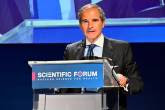
In opening the Scientific Forum, IAEA Director-General Rafael Mariano Grossi stressed that Rays of Hope is a call for action. Since its launch in 2022, the initiative has rallied global support to close critical gaps in cancer care. More than 100 countries are part of the initiative, which has mobilized over €100 million from governments, international partners, private-sector donors and other supporters. To date, more than 20 cancer centres have been opened, expanded or are under construction, over 150 diagnostic and treatment technologies have been procured, and more than 800 medical professionals have been trained in radiation medicine — all with support from Rays of Hope.
Mr. Grossi thanked the initiative’s supporters but stressed that much more needs to be done. “We are not talking here about things that are unattainable, that we cannot achieve, that demand investments in the billions,” he said. “It’s not impossible. Let’s do it together.”
Four years after I launched @IAEAorg’s #RaysOfHope, we are translating the promise of nuclear science into cancer care for people who previously had little or no access to it. More than 100 countries are receiving support, over 150 pieces of major cancer diagnosis and treatment… pic.twitter.com/bKVnlypgYG
— Rafael Mariano Grossi (@rafaelmgrossi) September 15, 2026
From Commitment to Action
“The Rays of Hope initiative offers practical meaning to our shared commitment to ensuring that advances in nuclear science and technology benefit people everywhere, particularly those in countries without advanced health systems,” said Vice President of the United Republic of Tanzania, Deogratius John Ndejembi in the forum’s high-level opening session. He detailed how his country had transformed its cancer care landscape in less than a decade, in part with support from Rays of Hope.
The ministerial segment that followed highlighted the tangible impact of Rays of Hope throughout Africa and beyond. Ministers emphasized that cancer is not only a health challenge but also a development challenge, requiring strong political commitment, international cooperation and sustained financing.
“Science can provide the tools, but partnerships and investment help bring these tools to the people who need them most,” said President of the OPEC Fund for International Development, Abdulhamid Alkhalifa which approved its first project with Rays of Hope in June 2026: building and equipping the first public radiotherapy centre in the Democratic Republic of the Congo. In thanking the OPEC Fund, Grossi noted that several development banks were following its lead and would also partner with Rays of Hope.
Expanding Access and Advancing Innovation
The Scientific Forum’s technical sessions discussed the essential role of radiation medicine in cancer care and examined the building blocks for expanding and sustaining access to care.
Although technology was recognized as a “force multiplier,” infrastructure and trained personnel are also crucial. Participants suggested that industry partnerships should include training and maintenance to maximize the impact of technology investments.
Research was also identified as a key pillar of sustainability, generating evidence, improving clinical practice and advancing diagnosis and treatment.
Reiterating that progress can be accelerated through collaboration, innovation and shared commitment, participants suggested that demonstrating both the health benefits and the economic returns of expanding cancer care can help build political support.
A Growing Network of Anchor Centres and Partnerships
Rays of Hope Anchor Centres were also a focus of discussion. Speakers highlighted how these regional hubs of excellence support the long-term sustainability of cancer care by strengthening national capacities in radiation medicine and fostering regional collaboration through education, training, quality assurance and technical cooperation.
In the margins of the 70th IAEA General Conference, Singapore’s largest public healthcare group, SingHealth, became the newest Anchor Centre, joining 20 other leading healthcare institutions in Africa, Asia, Europe and Latin America to strengthen cancer care in their regions and beyond.
The IAEA also signed Rays of Hope partnership agreements with the Principality of Monaco and in the private sector with AMEX Healthcare, Elekta, GE Healthcare, HTA Co., Ltd., RaySearch Laboratories AB, Siemens Healthineers and Vertual.
The Way Forward: Sustaining and Scaling Up Access to Cancer Care
The Scientific Forum’s closing session centred on strategic partnerships, innovative financing and scalable solutions to expand access to cancer care. Strong partnerships between the IAEA, Member States and donors were seen as critical, with the IAEA providing technical expertise, donors supporting long-term financing and countries leading implementation. Rays of Hope was cited as a compelling example of collaboration, demonstrating what can be achieved when governments, international organizations, healthcare institutions, development partners and industry align around a shared goal.
There was broad agreement on the need for a systems approach backed by coordinated and sustainable investment in all key elements of cancer care — including technology, infrastructure, workforce development, radioisotope supply chains and research.
In her closing remarks, IAEA Deputy Director General and Head of the Department of Nuclear Sciences and Applications Najat Mokhtar welcomed the progress achieved through Rays of Hope, stressing that not only individuals but their communities and societies benefit.
However, major challenges remain. Mokhtar emphasized that sustainable progress depends on national commitment and innovative financing. The IAEA can help connect countries with development banks, the private sector and other non-traditional donors, but she stressed that long-term sustainability must be country-led. She urged countries to share their plans and priorities with the IAEA so that support can be mobilized through partnership.