
Deploying IP-based NG911 throughout the US is expected to cost $5.8 billion to $9.27 billion—less than an estimate made almost a decade ago
By Donny Jackson, Editor, Urgent Communications
Deploying IP-based next-generation 911 (NG911) throughout the US is expected to cost US$5.8 billion to US$9.27 billion—at least 30 per cent less than was estimated almost a decade ago, counting inflation—according to an NG911 cost study released last week by the National Telecommunications and Information Administration (NTIA).
NTIA’s report is described as an “estimate of the remaining costs” needed from the federal government to pay for all US 911 centers to deploy NG911. It is the first such estimate since 2018, when the cost of NG911 implementation was estimated to be between US$9.5 billion and US$12.7 billion. While released in 2018, most of the research work for that cost study was done in 2016 and 2017, according to sources.
NTIA’s new lower estimate—even without considering inflation—is largely an acknowledgement that more than US$4.5 billion has been invested by many state and local jurisdictions to make NG911 a reality in the absence of federal funding and the emergence of software-based solutions.
“The estimated cost of implementing NG911 nationwide has declined since NTIA’s 2018 assessment, reflecting both state investments to date and a broader shift in the market from equipment-based systems to software-driven subscription models,” according to the report.
“As many states have made significant investments since 2018 and as the market has evolved toward lower upfront costs and recurring service-based pricing, the estimated remaining cost of nationwide implementation has fallen from US$9.5 billion to US$12.7 billion in 2018 to US$5.8 billion to US$9.27 billion today, a reduction of roughly 30 to 40 per cent that is even more significant after accounting for inflation.”
While the estimated total remaining cost for NG911 deployment is lower than it was in 2018, the nature of the expenditures also has changed, according to NTIA.
“The 2026 study finds that much of the cost of NG911 has shifted from upfront capital expenditures on equipment to recurring operational expenses tied to cloud-based software services,” an NTIA press release about the cost study states. “In practice, this means 911 is increasingly moving to a subscription-based model, with generally lower upfront costs that vary depending on local starting conditions and higher recurring costs than in legacy systems.”
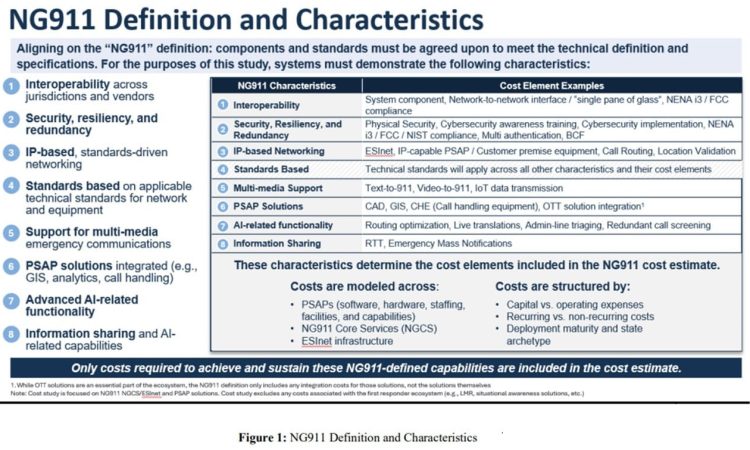
This latest cost study from NTIA is based on providing federal funding to pay for 911 centers achieving certain NG911 characteristics (graphic depicting the specifics is pictured above). In addition, no administrative costs to implement a grant program to distribute were included in the NTIA cost estimate, according to the report.
Many state and local officials today claim that their 911 systems already have completed the transition to NG911, but NTIA indicates that such assessments often are not entirely accurate.
“The 2026 study also found that, while several states have made significant progress toward NG911, even the most ‘mature’ systems often lack certain capabilities that would enable a complete end-to-end NG911 network—such as geospatial routing, the ability to transfer calls with accompanying data across jurisdictions, and real-time sharing of incident information with first responders,” according to the NTIA press release.
Having the new cost estimate from NTIA potentially could address a significant issue associated with efforts to pass legislation that would provide federal funding for NG911 deployments nationwide. Earlier this year, a House subcommittee advanced an NG911 funding bill—H.R. 6505—by voice vote, but the proposal did not include any monetary figures.
“While we are taking steps to advance this legislation towards law, we are still working on finding an appropriate dollar amount to fund this grant program,” Rep. Richard Hudson said in January. “It is critical we balance the need to fund this important program while making sure we maintain fiscal responsibility.”
It is also important for 911 centers that any federal NG911 funding approved by Congress be made available in timely manner that allows for appropriate planning. Congress reportedly almost passed legislation a few years ago that would have funded the NG911 transition with proceeds from proposed FCC spectrum auctions; however, the first priority of that bill language was to fund “Rip and Replace” efforts before NG911, and there was no certainty when—or if—enough month would be available for NG911.
Meanwhile, there also are logistical challenges associated with getting Congress to approve NG911 legislation, as all House members and many Senators soon are expected to focus on their campaign during the upcoming months, effectively reducing the amount of time that lawmakers can work on NG911 bills, according to Beltway sources. One potential reason for optimism is that the concept of bolstering 911 has bipartisan support, but that has not been enough to make significant federal NG911 funding a reality in the past.
APCO CEO and Executive Director Mel Maier said he hopes that the existence of the NTIA cost study will help generate support on Capitol Hill for a grant program that is designed to ensure that NG911 is deployed throughout the US.
“While we are continuing to review the report and its findings, this cost study presents an important contribution to the ongoing discussion and hopefully will spur momentum toward the adoption of a federal grant program to modernize 911 nationwide,” Maier said in a prepared statement provided to IWCE’s Urgent Communications.
“Advancing a nationwide federal grant program is critical to ensuring that public-safety telecommunicators across the country have the resources they need to protect their communities.”
NENA CEO John Provenzano expressed optimism that the release of the NTIA cost study will result in federal NG911 funding legislation being approved sooner.
“Today’s NTIA study reinforces what NENA has long emphasized: transitioning to next-generation 911 will require a sustained, multi-year, multi-billion-dollar investment,” Provenzano said in a prepared statement. “NENA calls on lawmakers to prioritize this critical public-safety investment during this Congress to ensure Americans can reliably reach 911 through voice, text, video, and data when they need help. The time to act is now.”
Executive director of iCERT, Sara Weston echoed this sentiment. “This study is important because it reinforces that a coordinated and sustained funding approach will be critical to ensuring nationwide, interoperable NG911 deployment,” Weston said in a prepared statement. “The updated analysis also recognizes that this is a multi-year infrastructure modernization effort, not a one-time upgrade.”