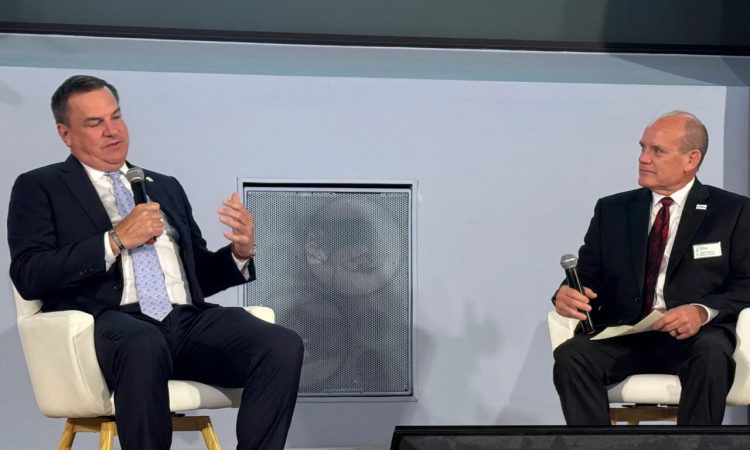

Rep. Richard Hudson (R-N.C.) says bipartisan support is be needed for NG911, particularly to secure the necessary votes for approval in the US Senate
By Donny Jackson, Editor, Urgent Communications
A key Republican member of the US House has said he believes a bill calling for federal funding of IP-based next-generation 911 (NG911) deployments nationwide could be enacted, but bipartisan support will be needed, particularly to secure the necessary votes for approval in the US Senate.
Rep. Richard Hudson (R-N.C.)—chairman of the House Communications and Technology subcommittee—said he believes the NG911 cost estimate released this spring by the National Telecommunications and Information Administration (NTIA) provides much-needed clarity to federal lawmakers.
“Whenever you’re trying to figure out how to fund a program, the first thing you’ve got to figure out is what is actually going to cost to fund it—let’s get a number that we all can agree on,” Hudson said at the Safer Buildings Coalition’s Wireless Tech and Policy Summit. “So I reached out to NTIA and asked them to help. They did a survey and came back with a cost estimate between US$5 billion and US$9 billion, which is significantly lower than the US$15 billion estimate made in 2018.
“Frankly, I was relieved. That’s more of a bite-sized number. So, that was a very important first step that was just done about a month ago. Now, we can all agree on what we’ve got to do to get there.”
Specifically, the NTIA cost study estimated the total cost for NG911 deployments to be between US$5.8 billion to US$9.27 billion. Hudson said he would like to fund the lower amount with unused money from the Broadband Equity Access and Deployment (BEAD) programme,, but he acknowledged that may be very difficult politically.
“The next step is finding a funding source that I can get the Democrats to agree with,” Hudson said. “One of the things I’ve identified is the non-deployed BEAD funding—about US$20 billion—that’s sitting out there and is available. If it was up to me, I’d take US$5 [billion] out of that US$20 [billion], and [say,] ‘Let’s fund it and move on.’ But there’s a lot of opposition on the other side to not use those funds for this purpose, so we’re looking at some creative ways to do it.
“Those conversations are happening. I mean, I could go put a bill on the floor and probably pass it out of the House to just take US$5 billion [for NG911], but I want it to be bipartisan. I want to get the policy right. And, frankly, to get it passed out of the Senate, it’s got to be bipartisan, because it requires 60 votes.”
Hudson said he believes “we’re making some progress” in gaining bipartisan support for the idea of federal funding for NG911 deployments across the US.
“I think, if we can agree on that funding piece, then I think it will be pretty smooth sailing getting it out of our committee and getting it out of the House,” Hudson said. “Then, it becomes a question of whether we can get the Senate to do this.
“We’ve been keeping our Senate counterparts appraised of what we’re doing and our progress. We’ve had initial conversations with them, but it’s going to require them to work with us. A lot of times, senators want to do things their own way and may have their own proposal, but I believe—particularly if we can get a bipartisan bill out of the House with a really good vote count—the Senate will be inclined to work with us on that.”
There is some reason for hope that a bipartisan agreement on NG911 could be reached was the recent unanimous vote in the House to approve a bill on another key public-safety-communications issue—the reauthorization of the FirstNet Authority, which is scheduled to sunset in February 2027 unless Congress takes action.
“FirstNet reauthorization has to be done by February of next year. I didn’t want to wait; I wanted to do it this year,” Hudson said. “So, we went to the Democrats on subcommittees and said, ‘Let’s do it this year.’ They agreed, and off we went.
“It’s been a very bipartisan, productive process, and I have to say that we passed reauthorization out of committee and out of the House unanimously, so that’s a great success story from our subcommittee.”
Despite the overwhelming bipartisan support for the FirstNet Authority reauthorization bill in the House, the item has not seen any tangible progress to date in the Senate. Beltway sources repeatedly have stated that the FirstNet Authority will be reauthorized, but the timing and details of the legislation remain uncertain.