
By Julius Ewudo, Cyber Era NG ASEAN Region Representative
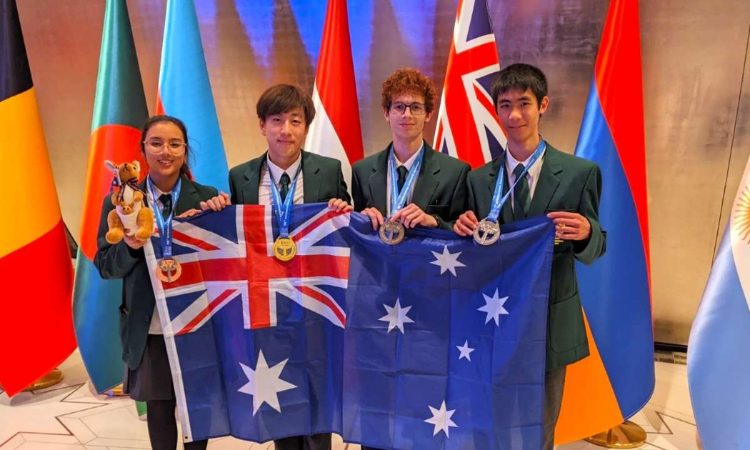
Australia’s most talented young scientists have excelled at the 2026 International Science Olympiads, returning home with an impressive collection of four gold, four silver and four bronze medals while competing against the world’s top science students.
After rigorous qualifying exams and extensive training, 17 students from high schools across Australia were selected to compete at the 2026 International Science Olympiads. Five of these students, comprising the Australian International Physics Olympiad team, were unable to compete due to a heightened travel warning for the host city in Colombia.
Proudly wearing the green and gold, twelve students represented Australia across three International Science Olympiads. Teams of four competed at the International Chemistry Olympiad in Uzbekistan, the International Biology Olympiad in Lithuania, and the International Earth Science Olympiad in Italy. Beyond the competition itself, the experience enabled students and accompanying team members to build lasting global connections and immerse themselves in the cultures, histories and environments of the host nations.
“All students selected for our Olympiad teams work incredibly hard, and we are so proud of their achievements,” said Australian Science Innovations (ASI) Executive Director Vanessa Kates. “The benefits of participating in these programs extend well beyond competition results, but it is important to celebrate their success and recognise the dedication behind it.”
“The Australian team competing in the International Earth Science Olympiad (IESO) in Turin, Italy, delivered a truly impressive outcome, earning three gold medals and a bronze,” said Ms Kates.
The strength of the Australian team at the IESO was evident, with Mali Hart, Hazel Chan and Yukai Yan each earning gold medals, while Stephanie Cheng won a bronze medal. Hazel was also recognised with the prestigious Mary Anning Award for Top Female Student. Her achievements reflect years of development through ASI extension programs, having previously attended two ASI residential science schools after excellent results in the qualifying exams.
Western Australian student Mali exemplifies how ASI programmes are identifying and supporting talented students from across the country. With its globally significant landscapes and strong links to the resources and earth science sectors, Western Australia provides an inspiring environment for young people to engage with the geosciences. Mali’s success demonstrates the importance of creating opportunities for students to explore earth and environmental sciences.
Also from Western Australia, Chloe Jain earned a bronze medal at the International Chemistry Olympiad in Tashkent, Uzbekistan. Chloe represented ASI at the Asian Science Camp in Thailand last year, and her experiences there, together with her success in Uzbekistan, highlight the value of international STEM opportunities. These programmes help students build global collaboration and networking skills and ultimately strengthen Australia’s future STEM workforce.
“We strive to connect with and support talented students from all states and territories, so it is wonderful to have students from Western Australia represented in our teams,” Ms Kates said. “It is also encouraging to see our online science extensions programmes helping promising regional students access opportunities and pathways that can lead to international competition.”
Olympiad student Isobel McAllister from Gippsland, Victoria, is one example of how regional students benefit from ASI’s programmes. Through online ASI talent development programs, the Curious Minds girls in STEM initiative and the 2025 Asian Science Camp, she developed the skills and confidence that helped her earn a bronze medal at the 2026 International Biology Olympiad in Vilnius, Lithuania.
Another success story is Cameron Wong, whose progression through ASI’s science extension pathways, including online and residential schools, helped him develop the knowledge, skills and experience that led to selection for Australia’s 2025 International Junior Science Olympiad team and a silver medal at this year’s International Biology Olympiad.
Also among this year’s high achievers was ASI alum Daniel Lin, who won gold at the International Chemistry Olympiad after previously earning a bronze medal while representing Australia at the 2025 competition.
“The achievements of our students across all Olympiad disciplines this year have been outstanding. Their results reflect the commitment, perseverance and talent they have demonstrated throughout the selection and training process, as well as the dedication of the teams and networks who support them every step of the way,” said Chair of the Board Associate Professor Stella Clark.
“We are incredibly proud of what they have accomplished. These results demonstrate the value of investing in young scientific talent and ensuring students, wherever they live, can access opportunities to develop their potential. Australia’s future STEM workforce is looking promising. Congratulations to all!”
Australia’s International Science Olympiads programs are run by not-for-profit Australian Science Innovations.