
By Cyber Era NG Special Correspondent
The International Telecommunication Union (ITU) will hold its next Plenipotentiary Conference, known as PP-26, in Doha, Qatar, four years from now, delegates from governments around the world have agreed.
The Plenipotentiary Conference, where delegates representing ITU’s 193 Member States set the organization’s four-year strategic plan and budget, is ITU’s highest decision-making body. ITU is the United Nations specialized agency for information and communication technologies, with a mission to help connect the world sustainably while leaving no one behind.
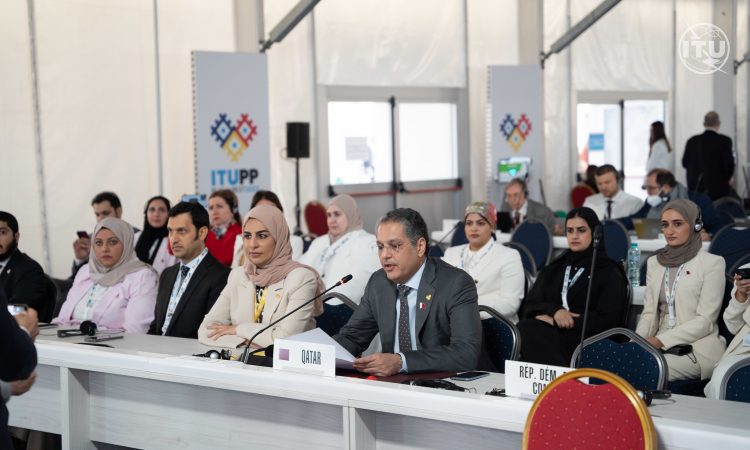
The decision to host PP-26 in Doha was adopted by consensus among the Member State delegations present Tuesday morning, during the second week of ITU’s current Plenipotentiary Conference, PP-22, in Bucharest, Romania.
The quadrennial gatherings serve as milestones on the path to global digital transformation, which ITU aims to align with United Nations sustainable development priorities.
“I applaud the decision to hold the next ITU Plenipotentiary Conference in Qatar, the successful host nation of previous important ITU events,” said ITU Secretary-General Houlin Zhao. “PP-26 – marking less than four years until 2030 – will support accelerated digital uptake, which is crucial for achieving the UN Sustainable Development Goals and ensuring that everyone is connected by the end of the decade.”
Zhao recalled Qatar’s hosting of ITU’s World Telecommunication Development Conference in 2006, the Connect Arab Summit in 2012, and ITU Telecom World in 2014.
Qatar’s Minister of Communications and Information Technology, H.E. Mohamed bin Ali Al Mannai, attending today’s session in person, called the quadrennial Plenipotentiary “the primary event where ITU Member States define the role of the Union in driving the development of telecommunications [and] information and communication technologies (ICTs).”
Following endorsements by delegates from countries and regions worldwide during today’s plenary session, Romanian official and PP-22 Chair Sabin Sărmaș noted the “overwhelming support” for Qatar to host the 2026 conference and offered to share best practices and insights with the next Plenipotentiary Chairperson.
“The State of Qatar has a strong ICT infrastructure that is compliant with international standards, making it one of the leading countries in the world in this regard,” Minister Al Mannai said in his proposal to host the conference in Doha. “The State of Qatar is also a world leader in organizing and hosting major events, including high-level global and regional conferences across a variety of sectors.”
ITU’s member states last week elected a new leadership team for 2023-2026, headed by Secretary-General-elect Doreen Bogdan-Martin, who is currently the Director of ITU’s Telecommunication Development Bureau.
Underlining the challenges ahead for ITU and its membership between now and the newly announced PP-26, ITU’s latest statistics show an estimated 2.7 billion people – or one-third of humanity – still lacking access to the Internet. Stark digital divides persist despite accelerating progress over the last two decades and a global connectivity surge during COVID-19.
Next ITU leadership team in place
Member States have completed elections for the five leaders at the UN specialized agency entrusted with driving digital transformation
Plenipotentiary Conference
Member States of the International Telecommunication Union (ITU) today concluded elections for the organization’s top five management posts, with voting for the bureau directors responsible for the three main areas of ITU’s work.
ITU Bureau Directors for 2023-2026:
Mario Maniewicz (Uruguay) was re-elected for his second term as Director of ITU’s Radiocommunication Bureau, which is responsible for maintaining and implementing the Radio Regulations treaty that harmonizes international spectrum use and satellite orbits, and for developing the related technical standards.
Seizo Onoe (Japan) was elected as Director of ITU’s Telecommunication Standardization Bureau, which is responsible for developing international technical standards for telecommunication and ICT (information and communication technology) through a membership of governments, private companies, and technical experts from around the world.
Cosmas Zavazava (Zimbabwe) was elected Director of ITU’s Telecommunication Development Bureau, which is responsible for mobilizing global efforts to connect the unconnected through promoting equitable and inclusive digital development, upgrading infrastructure and capacity for developing countries, and initiatives to extend the benefits of technologies to all.
They form the ITU leadership team together with Secretary-General-elect Doreen Bogdan-Martin (US) and ITU Deputy Secretary-General-elect Tomas Lamanauskas (Lithuania), both elected yesterday.
Each of the five elected officials is set to serve a four-year term starting on 1 January 2023.