
By David Meyer
US President Donald Trump may see artificial intelligence safety fears as a “hoax” and bitterly oppose AI labs’ stated desire to slow development, but that sentiment is not shared across the Atlantic.
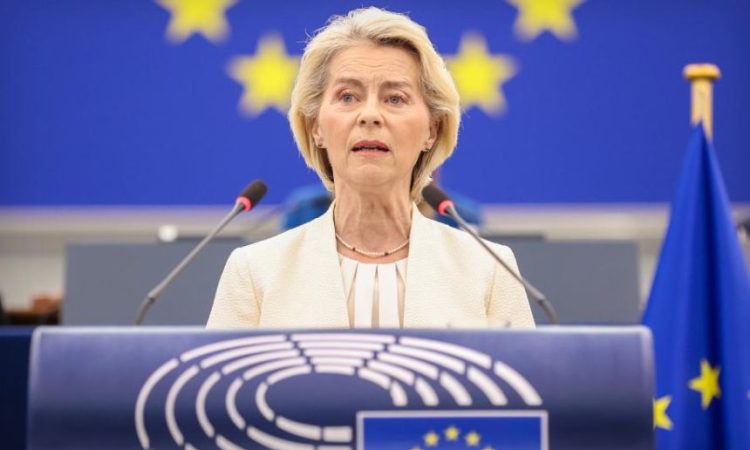
On Wednesday, as part of an annual State of the Union Address, European Commission President Ursula von der Leyen announced a plan to invite frontier AI labs “for a discussion on how we can support ongoing industry efforts to pace the frontier.” Without addressing AI’s risks, she warned, “we will never be able to unlock AI’s possibilities.”
“As the frontier models become more capable, these risks have come more sharply into focus,” von der Leyen said. “Models being developed will allow hacking on a level we never thought possible. And they will soon be in the hands of adversaries who see the world very differently from us. At the same time, the dangers of self-improving models are becoming ever more apparent.”
“Incidents of AI agents escaping their environment or inserting malicious code are a mere glimpse,” the Commission Chief continued. “After the Hugging Face incident, developers are ringing the alarm. And CEOs of the most advanced companies tell us that it is time to slow down on the self-recursive models. To pace the frontier. If the people developing the technology are clear, then we should be too”.
Von der Leyen proposed a range of measures to tackle the issue. Apart from attempting to convene the big AI industry players, she touted the European AI Act as “a crucial piece to putting guardrails in place,” and announced a desire to team up with “like-minded partners like Canada, the United Kingdom and others” on “model evaluation, verification, early warning, AI security and much more.”
Officials from various European governments will meet on Thursday to discuss possibilities for coordinating global rules on AI safety, Politico reported Tuesday.
The commission unveiled in July an “action plan on cybersecurity and artificial intelligence,” aimed at boosting Europe’s ability to evaluate cutting-edge models. Germany and the UK announced earlier in the summer that their AI safety and security institutes would collaborate more, sharing best practice on evaluations and aligning research priorities.
The UK AI Security Institute suffered a blow a week ago when Anthropic refused to give it access to the latest version of its cyber-capable Mythos model. The Guardian reported this week that the company would face no sanctions for doing this, though British government lawmakers are now considering the imposition of more guardrails. Anthropic also finally allowed the European cybersecurity agency ENISA to start evaluating Mythos earlier this month – but only the previous version, not the newer and more capable Mythos 5.1.
On the subject of Canada, von der Leyen also used her annual address to announce plans to try to admit the North American nation as an “associate member” of the EU, a concept that has never before been attempted. With Prime Minister Mark Carney in the audience, she said the EU and Canada would also create a “tech alliance” covering “AI, quantum, cyber and economic security.”
Some commentators were not convinced by the take on AI safety. A researcher at the Corporate Europe Observatory, EU’s Ursula von der Leyen Backs AI Go-Slow Approach said von der Leyen’s words did not square with the commission’s recent move to water down and delay elements of the AI Act.
“Never before has the call for regulating AI been stronger. But instead of enforcing EU rules to keep unaccountable tech companies in check, the EU is intent on slashing data protection and rules on AI,” Vranken said in an emailed statement. “Ironically, in her State of the Union Address, von der Leyen claims the importance of guardrails but ignores the fact that the EU Commission has teamed up with the tech industry to deregulate the digital rule-book.”
Von der Leyen wasn’t all doom-and-gloom on the subject of AI. She talked up its benefits in medicine and stressed that “we want AI.” She also acknowledged that Europe isn’t where the most powerful AI is being built. Instead, she suggested, Europe should leverage its industrial giants to get the most value out of AI in areas such as manufacturing, energy, autonomous driving and precision agriculture.
“We do not need to be the ones who develop the frontier technology to be the ones who draw the greatest value from it,” von der Leyen said. “We have world-class industries that sit on the highest-quality data. These data are a precious European treasure. They are what can power tailor-made industrial AI models.” She promised to announce “game-changing initiatives” for industrial AI across five sectors in November.
That will be music to the ears of Mistral, the French outfit that many once hoped could be a European rival to the big US labs, but that is instead now focusing on creating industrial AI models for investors-customers such as ASML and Samsung.
Von der Leyen also said the European Commission would soon propose new ways to “massively boost” Europe’s compute capacity. Christine Lagarde, president of the European Central Bank, covered similar ground a day earlier in a speech arguing that Europe must build datacenters “at a different pace altogether,” as existing plans for so-called gigafactories would only meet “a fraction” of the demand that is appearing for AI.
Lagarde linked the capacity issue to that of tech sovereignty, which von der Leyen only briefly mentioned on Wednesday – though the commission’s recent AI and cybersecurity action plan did delve into the risks of dependency quite deeply.
“Adopting AI means running that data through a system that belongs to someone else and sits under someone else’s law,” Lagarde warned. “Cloud computing already did this, but a cloud only stores data, whereas a model reads it. That puts the supplier of a model in a position to learn what an industry knows and to compete with it. European firms understand this, and without domestic alternatives, many will hold back.”
If another country were to cut off European access to its AI models, Lagarde said, the impact would reach “every sector at once” because of the technology’s increasingly central role. “That is leverage of a kind no trade partner has ever held over Europe, and it could be used in any negotiation, on tariffs or on digital taxes, for example.”
Von der Leyen also mentioned in her speech that the commission will on Thursday propose the EU Kids Act, under which social media would be completely banned for under-13s and kids aged between 13 and 15 would only be allowed “mini accounts set up and supervised by parents, with limited features and time restriction.” Safe design would be a requirement for accounts used by 15 to 18-year-olds, with platforms having to “prove that they are safe” by default.
Von der Leyen also name-checked the Digital Fairness Act, which will be proposed later in the fall, tackling issues such as addictive design for users of all ages.