
Government-affairs leaders for four key organizations cite encouraging progress, but obstacles remain—particularly in this calendar year
By Donny Jackson, Editor, Urgent Communications
Funding for nationwide next-generation 911 (NG911) deployment remains a primary federal priority for four key associations, but their leaders acknowledged that getting Congress to pass legislation by the end of the year will be challenging.
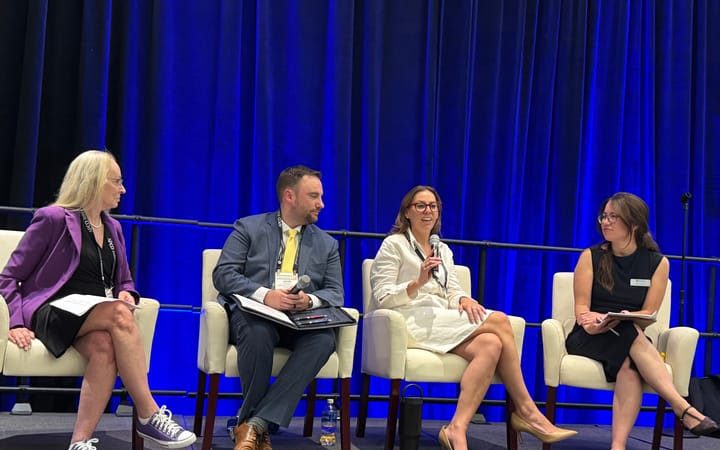
During a session at last week’s APCO 2026 conference in San Antonio, APCO International’s chief counsel and director of government relations, Nicole McGinnis expressed optimism that momentum is building on Capitol Hill to provide federal funding for NG911. McGinnis referenced sentiments from Rep. Richard Hudson (R-N.C.), who chairs the House Subcommittee on Communications and Technology.
“Recently, we were told that it is a huge priority—in fact, it’s Chairman Hudson’s top priority—to move forward with NG911 legislation, and there’s wide, substantive support for the bill, in terms of the substantive provisions,” McGinnis said during the session. “The discussion is now focusing on how much money.”
A study released in the spring by the National Telecommunications and Information Administration (NTIA) estimated that NG911 deployment throughout the US would require between US$5.8 billion and US$9.27 billion in federal funding (view this video to learn more about the assumptions made in the cost study).
“I know that there may be some discussion from folks whether the [NTIA cost-study estimate for NG911] was the right dollar number or whether there was something that should have been included, but it’s important, because it’s moving the discussion forward,” McGinnis said. “It’s directly responsive to a congressional request for updated numbers.
“It’s been helpful for us to … go [into a lawmaker’s office] and say, ‘You wanted updated estimates. You have what you asked for, in terms of this NTIA cost study. You should—and can—move forward with NG911 legislation.”
But director of governmental affairs for the Congressional Fire Services Institute (CFSI), John Drummond outlined the logistical difficulties in getting federal NG911 legislation passed this year, citing “the timing of this Congress—with August and October recesses, elections and the holidays—and just the fact that this Congress has been a little tricky.”
Director of governmental affairs for the National Sheriffs’ Association, Yesim Karaman echoed this sentiment.
“I would agree,” Karaman said during the session. “This year, specifically, is quite tough.”
Both Karaman and Harriet Rennie-Brown—executive director of the National Association of State 911 Administrators (NASNA)—reflected on the fact that it has been a decade since the NG911 NOW Coalition was established in 2016, but no federal-government grant program has been established to help fund the technological transition to IP-based NG911 technology.
Rennie-Brown focused on the need to find a revenue source for Congress to tap, if it decides to fund NG911 nationwide. With a previous proposal to use spectrum-auction proceeds—one that would not have generated enough funding for meaningful NG911 deployment—now “off the table,” other sources need to be considered, she said.
Both Rennie-Brown and McGinnis noted the possibility of redirecting unused money in the Broadband Equity and Access Deployment (BEAD) programme toward NG911 deployment, but both acknowledged that could be politically difficult. Rennie-Brown proposed another idea.
“I think, if it’s not something that comes out of leftover BEAD money, I really think—and this is an unpopular position—that Congress is going to have to make a decision that our internal public safety and progression to next-generation 911 is as important as other things and make a general-fund appropriation to next-generation 911,” Rennie-Brown said.
“I don’t think there’s going to be a magic want that creates a special source of revenue for funding for us. It will be Congress standing up and saying, ‘Yep, we want to make that investment.’”
Rennie-Brown also said it may be more beneficial for the 911 community to seek “small, targeted amounts” of funding from the federal government for NG911 initiatives, rather than continuing to seek a massive grant program that is designed to cover deployment costs comprehensively.
Despite the challenges, McGinnis said she is encouraged by the progress toward NG911 shown on Capitol Hill and expressed confidence that “unrelenting” advocacy by the four groups can help spark a positive outcome.
“Given the amount of interest, I’m going to be optimistic about it … I feel good,” McGinnis said.
In addition to NG911 funding, speakers in the session cited other legislative initiatives that they are prioritizing, notably efforts to have 911 telecommunicators reclassified in recognition of their public-safety roles. Most of the focus in recent years has revolved around state and federal legislation mandating such a reclassification, but the federal Office of Management and Budget (OMB) also is scheduled to reconsider the matter during the next several months and could address the issue on its own, according to the speakers.