
5G technology that dedicates network resources to public safety is making a difference in the one Texas city’s operation, official says in IWCE keynote
By Donny Jackson, Editor, Urgent Communications
Verizon’s network-slicing technology that dedicates network resources in a manner that is designed to ensure public-safety communications is not hampered by network congestion already is impacting operations in one Texas city, according to a keynote speaker at IWCE 2026.
A key capability enabled by carriers that migrate their networks to a 5G standalone core, network slicing was a much-anticipated technology within the critical-communications space, because it lets carriers dedicate network resources to specific user groups and even applications. Verizon’s network-slicing offering is designed to prioritize public-safety communications.
Chief infrastructure and communications officer for the city of Irving (Texas), John Chaney said Verizon’s network-slicing capability already is making a difference in his jurisdiction, based on the performance of the technology during the city’s big Fourth of July event.
“I can tell you that, from a previous event a year ago—when we were on another carrier’s network—our video trailers that were on that network started failing and became unusable as the public came in. From what we know that shouldn’t have been the case; it could have been a backhaul issue,” Chaney said recently during the IWCE 2026 keynote presentation. “But this past year, using Verizon slicing, it was just phenomenal.
“We were able to use slicing flawlessly through that event—and we had multiple video trailers, a command center and everything—and there were no issues whatsoever. We didn’t get a chance to test push-to-talk tethered on a device over that. But even with push to talk, in that scenario, Verizon gives you a [communications] highway. You’re not competing with other devices. It gives you a highway that you can use, and it’s just for public safety. It’s like a game-changer.”
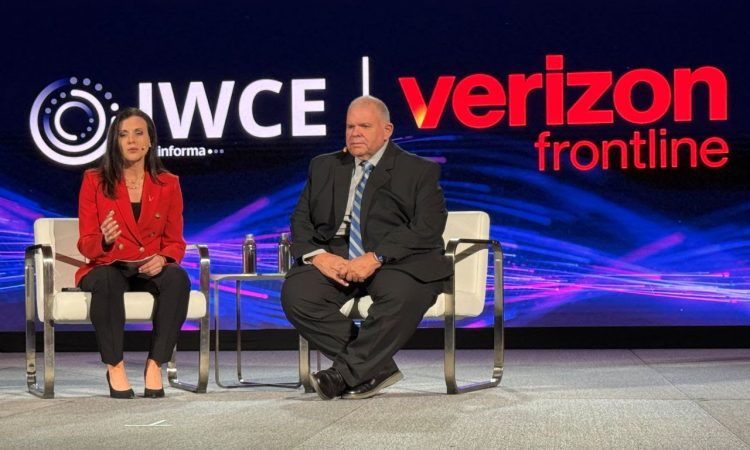
Vice president of public-sector sales for Verizon Frontline, Patty Roze shared the IWCE keynote stage with Chaney and said this type of performance for public safety while operating in congested environments is what Verizon was pursing when it began offering network-slicing service to public safety last year.
“It’s a dedicated lane,” Roze said during the keynote. “It’s a dedicated lane of the Verizon Frontline network that our public-safety agencies—and only our public-safety agencies—have access to, so it is providing that blue-sky day, even in crowded event or potentially even in a disaster.”
Throughout the keynote discussion with Roze, Chaney emphasized the importance of public-safety agencies implementing multiple layers of redundant connectivity during large events—including the use of service from multiple carriers—to ensure that first responders can communicate in even difficult environments. But such a strategy still requires agencies to have a trusted primary communications service, he said.
“You don’t know what could happen,” Chaney said, referring to preparations for this year’s World Cup. “You want to use the best network that’s available, because you want to make sure that you’re prepared, no matter what happens. You don’t want to stick all of your eggs in one basket; you want to have some resiliency and redundancy.”
Chaney expressed confidence in the connectivity that Verizon can provide to first responders via its 5G network-slicing technology.
“The game-changer for us has been Verizon [network] slicing,” Chaney said. “To be able to have a dedicated pipe on the wireless side—we’ve got fiber, microwave and all this stuff for resiliency—is just building those foundational networks and partnerships, so that you can support those first responders for drones, for AI, robotics and other things that they would use.
“The key is building the foundational-type networks to make sure that they’re the best.”
Roze said that public-safety agencies can anticipate having greater opportunities to leverage Verizon’s network-slicing technology in the near future.
“We launched that on routers, so it can be used on routers and any of the connected cruisers,” Roze said. “Coming soon, we will be launching this technology on phones, tablets and connected laptops, so we will be expanding the number—and types—of devices that will be able to access this network-slice technology. So, there’s a super exciting future coming for network slicing.”