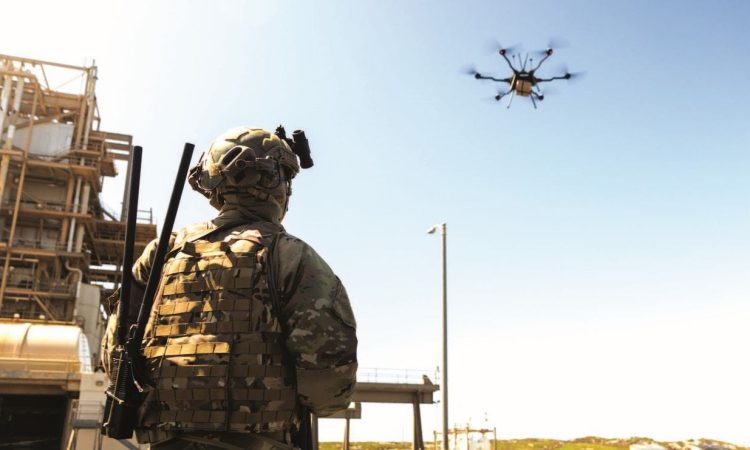

Motorola Solutions closes its US$4.4 billion acquisition of Silvus Technologies, which has developed hardware and software for its secure mobile ad-hoc network (MANET) technology that provides high-speed mesh connectivity to support drone operations in even hostile spectrum environments.
By Donny Jackson, Editor, Urgent Communications
Motorola Solutions announced that it has closed its US$4.4 billion acquisition of Silvus Technologies, which has developed hardware and software for its secure mobile ad-hoc network (MANET) technology that provides high-speed mesh connectivity to support drone operations in even hostile spectrum environments.
Motorola Solutions Chairman and CEO Greg Brown said the Silvus infrastructure-less solution—utilized by Ukraine to operate drones in its war against Russia—offers a significant opportunity for Motorola Solutions to make inroads into military communications, as well as providing a path to greater resiliency to communication in other mission-critical sectors.
“It’s video- and data-centric, so it’s all about ad-hoc, high-speed, infrastructure-less mobile, data and video communications,” Brown said last week during a call with financial analysts. “We see [Silvus being used] in defense. We see it in border security. Obviously, we see it in mission-critical deployments, primarily on the battlefield and adjacencies where there is intense conflict.
“But we also see it as complementary—complementary to LMR and complementary to video. We lead in land-mobile-radio infrastructure and devices. This gives us an opportunity to lead infrastructure-less mesh networks. Given our both Silvus and our heritage in LMR have a radio-frequency—or RF—centricity, I … think there is a 1-plus-1-equals-3 proposition, in terms of expansion to new markets. This is a great, great, great product.
“We love Silvus—we spent a lot of time on it, as a team. I heard from some people who said, ‘This thing actually looks too good to be true.’”
Motorola Solutions’ senior vice president overseeing North America government accounts, John Zidar said the Silvus deal–first announced in May–is Motorola Solutions’ largest acquisition since the company split from its commercial-device unit in 2011. Announced in May, the acquisition gives Motorola Solutions access to patented technology that is designed to provide resilient communications without the need to fixed towers or cell sites.
Silvus enables “self-forming, self-healing, infrastructure-less, on-body, on-person, on-tent, on-vehicle, scalable networks,” Zidar said during an interview with IWCE’s Urgent Communications.
“What’s special to us is the low latency. And secure and reliable. As well as distance. This is really how you form the mobile network. It’s constantly changing, but you can do it for distance.”
Zidar said the Silvus MANET offering represents a significant advancement in mesh-networking capabilities—both in terms of the Silvus technology and the hardware available to operate it—when compared to offering from Motorola Solutions’ mesh-networking unit that he sold more than decade ago.
“Think of it: You’re building a network on the fly,” Zidar said. “And as you’re adding bodies, you’re actually improving signal strength in RSSI.
“As long as you stretch it out, you could go hundreds of miles—even thousands of miles—if that’s the intent, and you don’t move the resources. Or, you start with one and you add resources, because you want to go to the south—just making that up. You can apply additional bandwidth via the units and pieces of the puzzle that you’re trying to add, which only extends coverage and improves throughput.”
Indeed, Excel Energy has deployed the proprietary Silvus technology throughout its utility network to support drone surveillance of its transmission lines to provide “highly encrypted” data from sensors across a total distance covering 13,000 miles, according to Zidar.
“They were pulling back data points from sensors along that [transmission-line route] to measure … and there was negligible … loss to complete their operation,” he said.
Silvus can support more than 550 nodes in a single Mobile Network Multiple Input Multiple Output (MN-MIMO) network, which is enabled by its StreamCaster radios, according to information provided by Motorola Solutions to IWCE’s Urgent Communications. Silvus also has proven that its MANET solution can support air-to-ground links as long as 300 miles under ideal circumstances, according to Motorola Solutions.
Zidar said the Silvus technology was used to support communications during a special security event conducted as part of the presidential inauguration early this year.
“They used the MANET radios to create basically a citywide mesh network,” Zidar said. “It supported real-time video feeds across the US Secret Service from both ground and airborne positions—whether airborne meant drone or helicopter—and [from] the soldiers and Secret Service individuals on the ground.”
Motorola Solutions Executive Vice President and CTO Mahesh Saptharishi said the Silvus technology is certainly capable of being used to control drones in North America, but securing access to licensed spectrum could be challenging in the near term. However, the spectrum-monitoring component of the Silvus technology soon could be used to help detect the locations of unauthorized drones.
“[Spectrum monitoring] is probably very important to talk about in the context of drones—being able to detect drones, in this case,” Saptharishi said during the call with financial analysts. “As part of our overall drone strategy, the ability to detect drones not just with radar—the most common way of detecting drones today—but with RF, we believe … positions us uniquely in that space.”
When used in concert with other existing and emerging technologies, the flexible Silvus MANET networking functionality could play a key role in delivering the most robust and resilient mission-critical connectivity available to responders, Zidar said.
“Agencies—whether federal, state or local—could have a device or units that have LMR, broadband—FirstNet, Verizon or T-Mobile for LTE 4G or 5G—but also LEO [satellite-direct-to-device service] as it becomes commercially available, in addition to mesh,” Zidar said. “That’s resiliency and redundancy packed in one place. As you know, there aren’t a lot of LMR towers hanging off the side of cliff, nor are there cellular-carrier towers. But there could be LEO satellite [connectivity], or there could be MANET mesh from Silvus.
“There’s no 100 per cent guarantee [for reliable communications], but that’s as close as we think we can get to it, with layers of resiliency and redundancy.”