
AT&T continues to make progress testing satellite-direct-to-device technology to fill terrestrial-network coverage gaps for public safety, including the execution of the first voice-over-LTE (VoLTE) call via satellite through the carrier’s network core using AT&T spectrum, according to a company official
By Donny Jackson / IWCE’s Urgent Communications
AT&T continues to make progress testing satellite-direct-to-device technology to fill terrestrial-network coverage gaps for public safety, including the execution of the first voice-over-LTE (VoLTE) call via satellite through the carrier’s network core using AT&T spectrum, according to a company official.
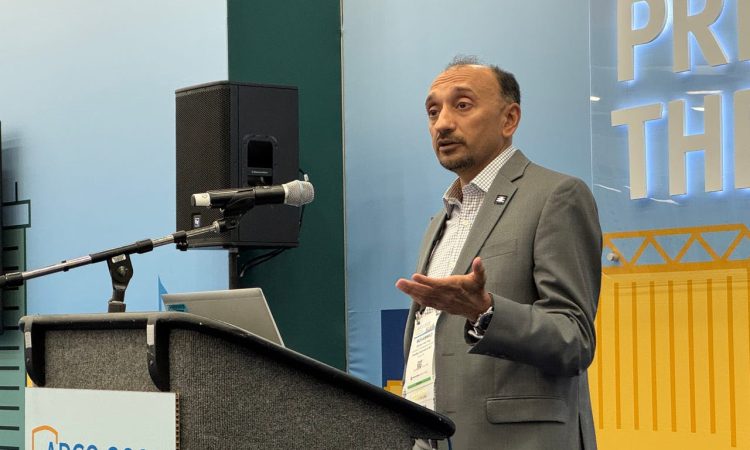
AT&T’s lead product manager overseeing the FirstNet satellite-direct-to-device initiative, Mohammad Baig said the VoLTE test was executed with satellite-direct-to-device partner AST SpaceMobile.
“Just last week, we placed the first carrier-native VoLTE call through AST’s system using AT&T spectrum. That had not been done to date,” Baig said during a July 28 presentation at the APCO 2025 event in Baltimore. “We’ve done video calls, and as cool as that is, making that basic VoLTE call is a huge step forward.
“This was using AT&T spectrum through our core, which—in our opinion—is a huge step forward.”
By having these communications routed through through the network core—be it the FirstNet core or AT&T’s commercial core—public safety would receive the same quality of service, priority and preemption functionality that it gets when communications traffic is routed over a terrestrial network operated by AT&T, Baig said.
Manufacturers like Apple and Google have introduced devices that support text-based messaging via satellite-direct-to-device technology in locations where carriers do not have terrestrial-network coverage—offerings that Baig described as “revolutionary,” noting that the capability already has been credited for saving lives.
As the contractor to the FirstNet Authority, AT&T is working with AST SpaceMobile to provide public safety with a satellite-direct-to-device service to unmodified cellular devices that more closely resembles the user experience when connected to a terrestrial cellular system—albeit with lower data speeds, Baig said.
“The goal here is to provide a basic level of connectivity—messaging, voice, low-bandwidth data, location services—by using Band 14 [spectrum in the 700 MHz band licensed to the FirstNet Authority], while also offering mission-critical push to talk [MCPTT],” Baig said. “There are text-based services out there today. Our goal is to make it so that you have a bare-minimum level of connectivity available to public safety in those areas where we have not been able to deploy terrestrial service.
“If you think about west of Texas and all of the wide-open space where there is no terrestrial service available, this is a solution that will be the primary service when we eventually deploy and provide that [satellite-direct-to-device] service.”
But Baig said the public-safety community should not perceive satellite-direct-to-device service as a replacement for traditional terrestrial-network coverage—or even coverage from deployable solutions like SatCoLTs and CRDs—but as an augmentation for the coverage provided through those offerings.
“The goal is to complement that service … and fill in [coverage] where we have those gaps, for whatever reason—terrain or whatever issues,” Baig said.
“It’s important to note that this is another tool in the toolbox. FirstNet has a long list of truly unique items that we’ve brought to the marketplace. This is going to be another one of those things.”
Baig did not provide an updated timeline about when satellite-direct-to-device services would be offered by AT&T to FirstNet public-safety users, although a FirstNet Authority official in June said the organization expects to invest in the technology sooner than originally anticipated, based on the positive development of the technology.
As he has in the past, Baig tried to temper user expectations for the performance level of the FirstNet satellite-direct-to-device service, particularly when it launches.
“At launch, this is primarily a coverage play,” Baig said. “Obviously, the bandwidth that will be supported is something we’ll look at as we grow the system. But initially, our goal is to get Band 14 included—as you’ve seen in some of the FCC filings—and Band 5 and Band 12 [AT&T commercial spectrum].
“Just to clarify, this is not going to be something where you can stream 4K video right at launch. The goal is to give operators, incident commanders and front-line personnel a basic level of situational awareness. To do that, you don’t need 40 Mb/s or 100 Mb/s.”
AST SpaceMobile and other satellite-direct-to-device providers are awaiting regulatory approval to deploy the number of low-Earth-orbit (LEO) satellites to provide contiguous coverage throughout the continental United States and around the world, but the FCC has expressed interest in streamlining the approval process for the technology.
And Baig said there is still work to be done to ensure that AST SpaceMobile’s LEO satellites effectively act as cell towers in space, as the pioneers of satellite-direct-to-device technology have envisioned. For instance, Baig acknowledged that the handoff of a call as a user moves from terrestrial-network coverage to satellite-direct-to-cell coverage remains “a work in progress” at this time, although the goal is to make such transitions seamless to the users.
While such challenges remain, Baig also noted the significance of satellite-direct-to-device technology offering a way for carriers to tackle a longtime problem of outdoor coverage gaps in their terrestrial networks.
“The amazing part here is that, 10 or 15 years ago, who would have thought that we would even be having this conversation?” Baig said. “This is the beauty of the innovation that is occurring in this market space.
“There are a lot of other operators that have talked a lot about this. Our goal is that, when we launch, we have the services that public safety needs and desires, above and beyond messaging, and that we take this service to a place where public safety can actively use it in those deployment scenarios, such as ski patrol and wildfire response.