
FirstNet Authority plans to invest money into satellite-direct-to-device technology in cooperation with FirstNet contractor AT&T–a service that is designed to address most outdoor coverage gaps in the nationwide public-safety broadband network (NPSBN)–but the timing of the offering remains unclear
By Donny Jackson, Editor, Urgent Communications
FirstNet Authority plans to invest money into satellite-direct-to-device technology in cooperation with FirstNet contractor AT&T–a service that is designed to address most outdoor coverage gaps in the nationwide public-safety broadband network (NPSBN)–but the timing of the offering remains unclear.
AT&T’s lead product manager overseeing the FirstNet satellite-direct-to-device initiative, Mohammad Baig said the long-term goal is to have satellite-direct-to-device service—through provider AST SpaceMobile—provide some level of broadband connectivity, the initial offering will be designed primarily for fundamental coverage. Satellite-direct-to-device functionality will be designed to be a “service of last resort,” he said.
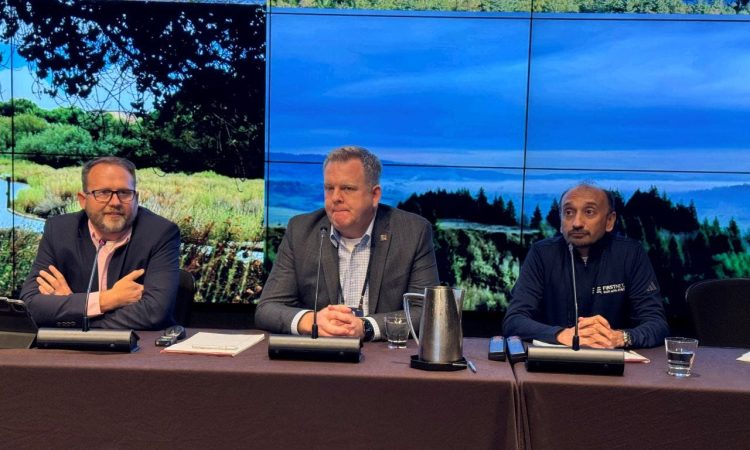
“We know that there are still pockets of the country we simply cannot cover. That’s where satellite-to-device services will come into play,” Baig said during a session at the 5×5 Summit conducted last month in Bellevue, Wash. “The ground reality is that we actually want you on our terrestrial network, first and foremost—that’s where the best experience is.
“If that is something that is unavailable for whatever reason—it might be geography, it might be terrain, it might be remoteness—that’s where our goal is to drop in the satellite-direct-to-device services. That satellite-direct service, at initial launch, will be communication wherein you’ll get basic data, basic voice and basic messaging capability to get public safety up and communicating … while you are waiting for those additional communications assets to be brought on scene.”
Chief of the support division for the Boulder County (Colo.) Sheriff’s Office, Brian Zierlein said such coverage capabilities would make a difference in his jurisdiction, which includes significant rural areas. The lack of terrestrial coverage in parts of his jurisdiction has limited its ability to adopt and fully implement certain technologies, he said.
“Half of my county doesn’t have terrestrial cell coverage at all,” Zierlein said during the 5×5 Summit session. “With this, it gives us that low-bandwidth opportunity to connect the basics that so many people take for granted every day—just basic MDC [mobile data computer] data, basic AVL locations.
“The cool thing about this is for everyone—whether they’re near their vehicle, or whether they have Starlink [dish-driven broadband service] or not, they’ll be able to access basic data services and voice services any time, even with zero terrestrial cell coverage.”
Senior director of the FirstNet Authority’s roadmap-development division, Brian Hobson said satellite-direct-to-device service was envisioned to be part of the NPSBN-enhancement plan approved by the FirstNet Authority board early last year, but the functionality could be available sooner than expected initially. In fact, the FirstNet Authority is in the “final stages” of work to make such an investment, he said.
“We did not originally have it going this soon; we didn’t think initially that the technology would be quite ready,” Hobson said during the 5×5 Summit session. “But the trip we made [to AST SpaceMobile in Midland, Texas], and the conversations we’ve had, have proven that it was ready sooner than planned.”
Hobson emphasized the importance of the FirstNet Authority’s partnership with AT&T in this initiative.
“They are pursuing this on the commercial side, so there is work that they are already doing, where we don’t have to pave the way for this technology all on our own,” Hobson said. “Rather, we can leverage what they’ve started, and then we can figure out how we can apply this for public safety and for FirstNet that’s incremental to what they’re already doing on the commercial side. We’re not having to do this and bearing 100% of that cost.”
Baig echoed this sentiment from the AT&T perspective, noting that that FirstNet Authority investments could allow satellite-direct-to-device service to be offered sooner in locations that are economically difficult to justify. One potential example of this could be Alaska, which has a sparse population in an enormous area and many locations from which seeing satellites in the southern sky is difficult, if not impossible.
“Alaska is a challenge; we recognize that,” Baig said. “It certainly is on the roadmap, but it certainly is not on the near-term roadmap.
“That’s because—if you think about orbital geometry—you end up having to deploy, in essence, one bird [satellite] just to cover those extreme northern latitudes. That doesn’t preclude somebody like the FirstNet Authority from stepping in and saying, ‘There’s an opportunity here that we need to address.’ At initial launch, our focus is CONUS [the continental United States].”
No prospective launch date for FirstNet satellite-direct-to-device service was provided during the session, but Baig tried to temper expectations about what the data-throughput capabilities would be when the offering is first available.
“If you’re referring to a data warehouse, where you’re needing to interact with your data in the field, I’d be cautious about assuming—at initial launch—that this would be something that would be able support that,” Baig said.
“The goal of this at launch will be something wherein we’re going to look at basic comms, basic situational awareness, and basic low-bandwidth data. As the service matures, we’ll think about additional capabilities.”
AT&T does not plan to deploy satellite-direct-to-device service everywhere, particularly where it provides terrestrial coverage, Baig said. However, if terrestrial coverage is lost—for instance, if cell towers are knocked out by a natural or man-made disaster—the long-term plan is to be able to redirect satellite spot beams to provide some level of connectivity to the impacted area, he said.
In terms of rural areas not covered by the FirstNet terrestrial network, public-safety should be able to count on satellite-direct-to-device service to provide connectivity, according to Baig.
“Where we do deploy it, it will be a persistent service available to public safety at all times,” he said.